.png)
Background image provided by jacob Licht via Unsplash.
TL;DR: Boston’s Community Clean Air Grant Program offers up to $200,000 for nonprofits to fund local projects that reduce air pollution, improve public health, and engage communities. Applications are open from April 1 to June 30, 2026, with priority given to projects that show clear, measurable impact and strong community benefit.
What is the Clean Air Grant Program?
The Boston Air Pollution Control Commission (APCC) works to achieve and maintain healthy air quality throughout the city, promoting public health and reducing Boston’s contribution to climate change.
The APCC oversees the Community Clean Air Grant Program, which is an annual grant program that was successfully relaunched in 2025. Already, the program has awarded $1,257,480 to 9 projects.
The Community Clean Air Grant Program helps nonprofit organizations carry out community-based projects aimed at improving air quality, lowering exposure risks, and raising awareness of air pollution-related environmental and public health challenges. The goal is to promote clean air and address climate change at the local level.
Who is eligible for funding?
The lead applicant and fiscal sponsor for all proposals must be a nonprofit organization. However, partnerships with businesses and other entities are encouraged. The nonprofit should seek funding for a community-based project that reduces, mitigates, or monitors air pollution in the City of Boston. The project should directly address air pollution through mitigation, abatement, monitoring, or utilizing local air quality data to educate the community.
Projects that already have dedicated grant opportunities at the city, state, or federal levels will not be funded through the Community Clean Air Grant Program. This means that projects for tree planting, building decarbonization, and e-bikes will not be eligible for this grant. Yet, these types of projects are still encouraged to pursue other funding opportunities listed within the grant program web page.
In order to apply, you also need to become a registered vendor with the City of Boston and have received your vendor ID. Instructions on how to register can be found here. The instructions can also be found in other languages on the grant program web page.
Application Guidelines
In order to qualify for funding, the projects must serve the public interest by achieving one or multiple of the following goals:
- Reducing or eliminating local air pollution sources, producing measurable air quality improvements
- Mitigating the negative health impacts of air pollution exposure, focusing on the populations that are the most vulnerable.
- Enhancing community capacity to decrease, mitigate, prevent, or monitor local air pollution.
Funded projects should be completed within one year. However, the APCC will still consider proposals with a duration of up to two years if the project’s potential impact justifies the longer timeline.
Up to $200,000 in grant awards are available, but funding requests should match the scale and impact of the proposal. Applicants are allowed to submit multiple proposals. However, an applicant can only be awarded funding for one project per fiscal year.
How will applications be prioritized?
Several factors determine which applications will be prioritized. The APCC will consider the project’s possibility for direct and measurable impact on local air quality and community health, as well as whether or not the project has a clear and achievable plan, including a realistic timeline that falls within one or two years. The project should also have a budget with limited administrative overhead and a strong evaluation component so that it can properly quantify its impact.
The Community Clean Air Grant Program provides several resources to help nonprofits with their application. These include a MassEnviroScreen Tool, a Centers for Disease Control and Prevention - Asthma Rates Map, and a publicly available list where potential applicants can add their contact information to collaborate with each other.
Applicants can also complete an optional preliminary proposal using a provided template. By completing and emailing this preliminary proposal by the end of the day on May 15th, 2026, applicants can receive formal feedback from the APCC before the application deadline. Preliminary proposals must include a budget attachment.
Application timeline
Applications opened on April 1st, 2026, at 9:00 AM. They will close on June 30th, 2026, at 4:00 PM. After submitting your application, you should receive an email confirmation. You will be updated on the status of your application by August, 2026.
The APCC will be hosting two information sessions, the first on April 15th and the second on April 30th. They also host weekly office hours on Wednesdays from 2 - 4 p.m. The APCC can also be found at several community events.
Learn more and apply
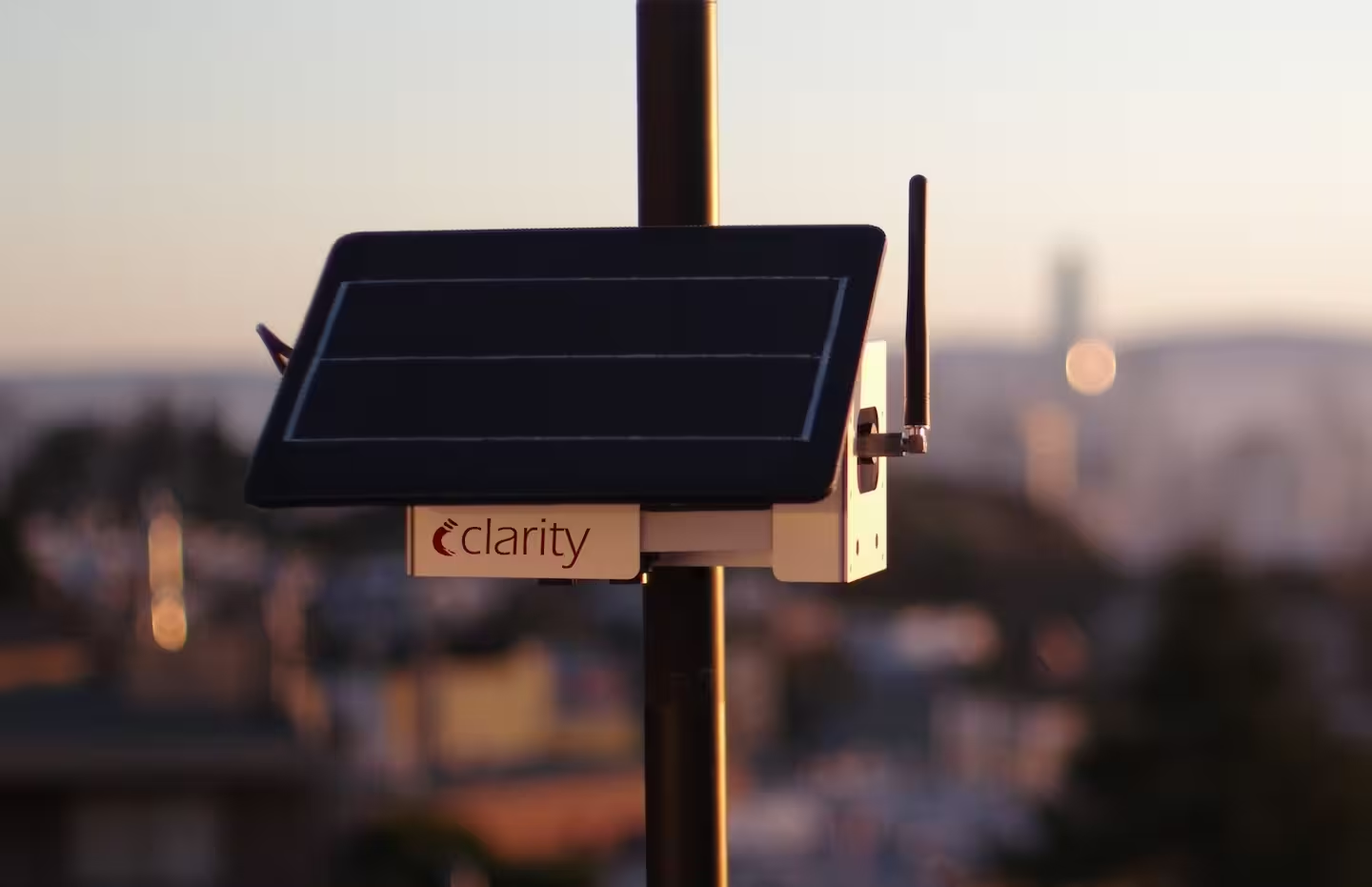
You can learn more about the Community Clean Air Grant Program here and apply here. Please feel free to contact us if you are interested in submitting a proposal for air quality monitoring using Clarity’s air pollution measurement equipment!
Browse our curated list of Air Quality Monitoring Funding and Grants to discover relevant opportunities for air quality monitoring initiatives.