
TL;DR — While carbon dioxide is the most well-known greenhouse gas, many other air pollutants have either direct or indirect impacts on the climate. Many substances in the atmosphere, in addition to acting as air pollutants with negative health and environmental impacts, also play a role in atmospheric warming and climate change. The complex relationship between climate change and air quality means that many of these substances have an array of negative impacts over time scales that can also vary broadly. Given the critical and increasingly time-sensitive nature of stopping climate change, it's important for us to take stock of all of the mitigation opportunities available to us. Doing so will require looking past CO2 — the traditional barometer for climate change — and starting to rigorously measure and reduce emissions from other sources.
The complex ties between air quality and climate change
Climate change is an incredibly dynamic, complex phenomenon that involves the interaction of many different air pollutants and atmospheric processes. Over time, these dynamics result in long-term shifts in temperatures and weather patterns driven by human activity.
In addition to warming temperatures, climate change also presents secondary consequences such as:
- Severe droughts
- Water scarcity
- Intense fires
- Rising sea levels
- Flooding
- Melting of polar ice
- Catastrophic storms
- Reduced biodiversity
- Reduction of GDP
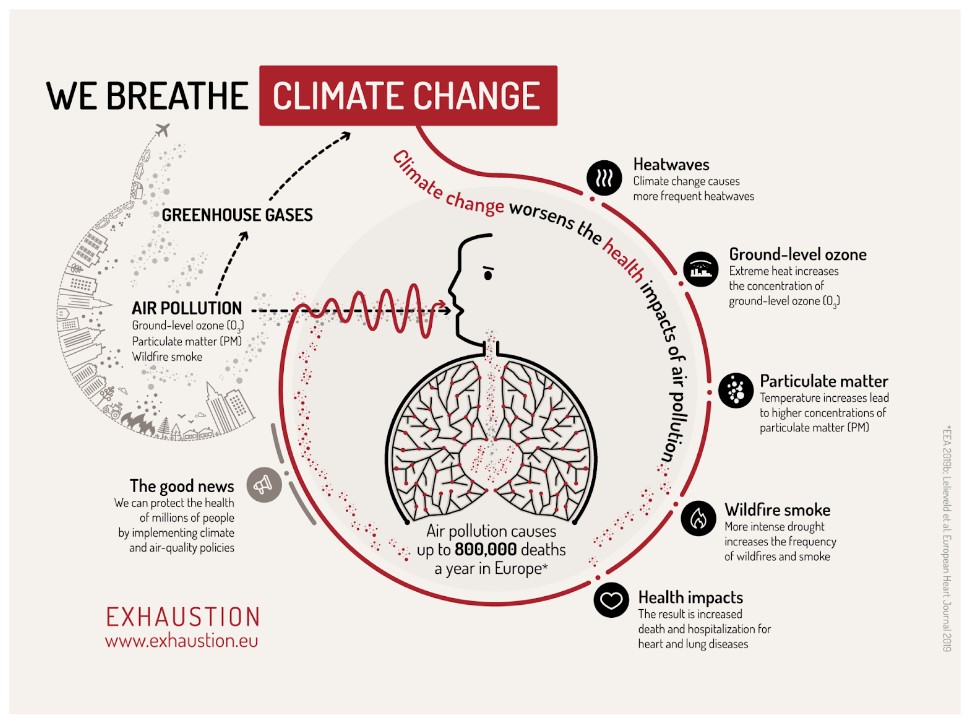
Feedback loops: Climate change drives wildfires, deteriorating ambient air quality and further accelerating climate change

Climate change's intricate relationship with air quality means that these two environmental forces have a complex interplay, with each impacting the other. We often think of air pollution as a driver of climate change, but research is increasingly showing that a changing climate can also drive air pollution in feedback loops.
Large bodies of water, such as the Great Salt Lake in Salt Lake City, Utah, and the Owens River in Los Angeles, are significantly drying out due to the increasing temperatures and environmental damage that climate change brings. These dry lakebeds and riverbeds become significant sources of dust pollution with extremely high levels of PM10, with the Owens Lake area having as much as 138 times more PM10 than what the EPA deems safe.
In the Great Salt Lake, wind storms carry the lakebed's high levels of arsenic into the air, exposing the residents to these toxins. The drying lake means increasing salt levels that threaten the ecosystem balance and health of the algae that allow the lake's brine shrimp to survive — experts see the situation as on the precipice of ecosystem collapse.
Ecological collapse can also mean economic collapse — as the Owens Lakebed dries and is now covered in gravel in some areas in an attempt to reduce dust, the once-booming town of Keeler now has just 50 residents.
According to new research, the global economy could lose 10% of its total economic value by 2050 due to climate change. This amount also varies region-by-region, with a predicted:
- 5.5% to 26.5% decrease to GDP in Asia, with a 24% hit to GDP in Asia specifically
- 10% loss in the United States, Europe, and Canada
- 4.7% drop in GDP in the Middle East and Africa
While climate change and air quality are inextricably connected, the complex interplay and overlapping causes at play also mean that there is the potential to mitigate both environmental crises in tandem. To learn more, read our blog about the climate change co-benefits that come with improving air quality.
To effectively combat climate change, we need to deeply understand its causes. Carbon dioxide (CO2)'s connection to climate change is well known, as we understand that:
- Atmospheric carbon dioxide absorbs less heat than other greenhouse gases but is more abundant, stays in the atmosphere longer, and is responsible for a significant portion of Earth's temperature rise.
- While CO2 is a normal component of the atmosphere, its levels have risen substantially — before the Industrial Revolution, average levels were about 280 parts per million (ppm), but in 2020, CO2 levels reached 417 ppm, and they continue to rise at about 3 ppm per year. This spells out a troubling future, as atmospheric carbon dioxide levels continue to rise with little substantial movement towards reducing this trend.
- Carbon dioxide has many negative impacts on environmental health, including ocean acidification that affects marine health and ecosystems across the globe.
But what about the impacts of other air pollutants? Given the critical and increasingly time-sensitive nature of stopping climate change, it's important for us to take stock of all of the mitigation opportunities available to us. Doing so will require looking past CO2 — the traditional barometer for climate change — and starting to rigorously measure and reduce emissions from other sources. Importantly, while the impacts of CO2 are often discussed at the global scale, many of the other pollutants that play into climate change require much more localized measurement and intervention.
The role of greenhouse gases in atmospheric warming
Many air pollutants act as greenhouse gases, which are substances that absorb high levels of heat and solar radiation as they enter the atmosphere, thereby trapping the heat in this zone rather than allowing it to be released back out into space.
The structure of greenhouse gases causes them to absorb heat. The atoms of greenhouse gases — such as CO2, methane, water vapor, and nitrous oxides — are held loosely enough together that they vibrate when they absorb heat, causing them to release radiation that may either be absorbed by another greenhouse gas in the atmosphere or travel down back to the Earth's surface.
Most of the gases that make up Earth's atmosphere are nitrogen and oxygen, which do not absorb heat. Though greenhouse gases make up a relatively small portion of the composition of Earth's atmosphere, they have a substantial impact on the warming of the atmosphere.
The greenhouse effect is a natural process, without which Earth's temperature would be below freezing — however, it is the strengthening of the greenhouse effect caused by anthropogenic greenhouse gases and climate feedback loops in our atmosphere that is cause for concern. But how do we measure the impact that anthropogenic emissions have on the climate?
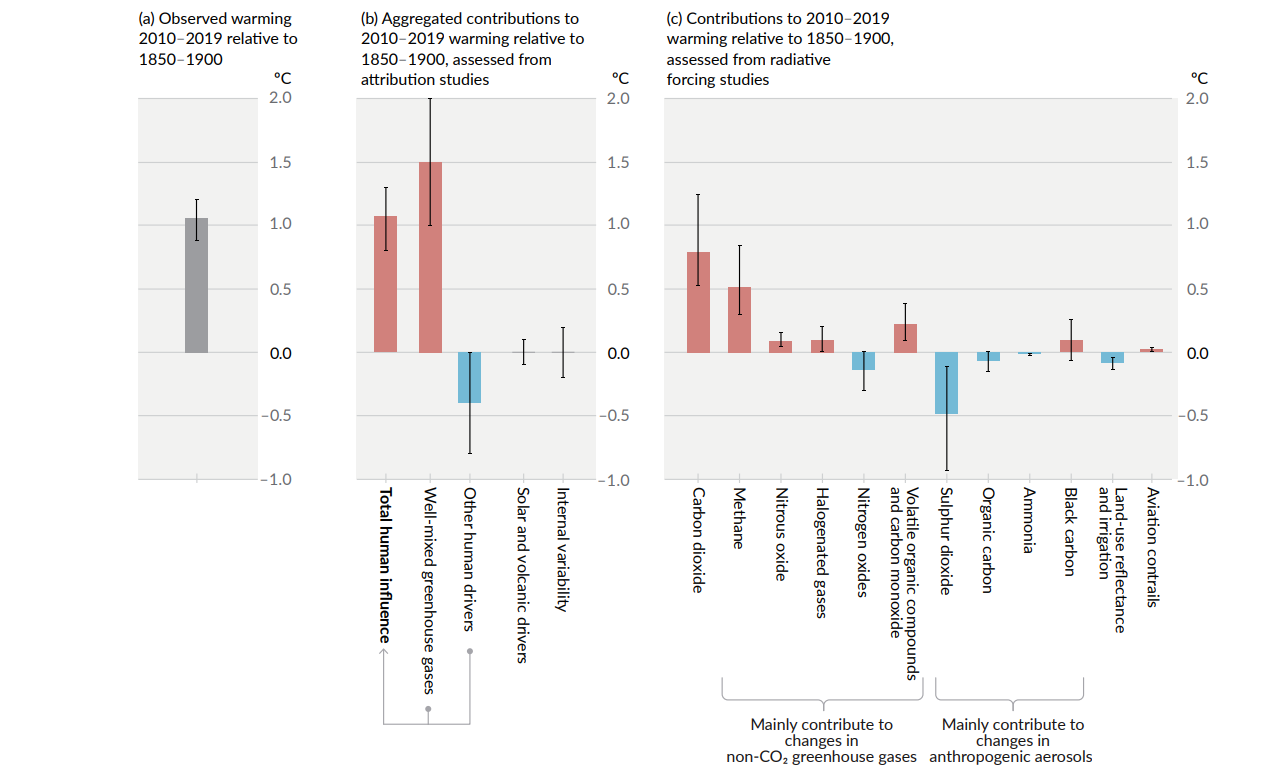
Global warming potential (GWP) is one term often used when discussing climate change that compares the global warming impacts of different substances. GWP measures how much energy is absorbed by 1 ton of the given gas compared to the amount absorbed by 1 ton of carbon dioxide typically over a 100-year time period — thus, a larger number indicates a larger warming potential.
Radiative forcing, another common climate change metric, looks at how the amount of energy entering Earth's surface differs from the amount that leaves it. When more radiation enters the Earth's atmosphere than leaves it, a warming effect results.
Examining the impacts of NAAQS air pollutants on climate change
The National Ambient Air Quality Standards (NAAQS) set out by the United States outline six different air pollutants of great concern, most of which also play a significant role in climate change.
Ground-level ozone
Ground-level ozone (also called tropospheric ozone) is a short-lived climate pollutant and greenhouse gas that contributes to the warming of the atmosphere. As a substance, it absorbs radiation, meaning that ozone acts as a greenhouse gas that increases the temperature of the atmosphere.
It is important to note that this type of ozone — the kind that is also an air pollutant — is different from stratospheric ozone, which forms naturally in the upper atmosphere and protects us from ultraviolet rays from the sun.
Ground-level ozone forms when nitrogen oxides and volatile organic compounds, two other types of air pollutants, react in the presence of sunlight and heat. To learn more about ground-level ozone as an air pollutant, read our blog here.

Because many ozone precursors are emitted from climate-sensitive natural sources such as wildfires and lightning, experts expect concentrations of ground-level ozone to increase due to climate change. Increasingly frequent and drastic wildfire activity in the western United States, for example, also affects ozone levels.
Interestingly, ozone has a complex relationship with heat. Typically, when heat increases, so do surface-level ozone concentrations. Ozone production increases at high temperatures, and emissions of certain components of the pollutant also increase. The weaker winds that tend to come with high heat also cause stagnation that results in these higher concentrations.
Because carbon dioxide is probably the most well-known greenhouse gas, we can compare other air pollutants that act as greenhouse gases to understand their intensity. Ground-level ozone has a radiative forcing effect that is about 1,000 times as strong as carbon dioxide, with its annual global warming potential equivalent to between 918 and 1022 tons of carbon dioxide. Though this pollutant has a much stronger warming effect, it decays in the atmosphere much more quickly than CO2, resulting in shorter-lived effects.
However, it is difficult to quantify the exact warming effects of ozone because it does not distribute uniformly across the globe. The Intergovernmental Panel on Climate Change Third Assessment Report, containing the most widely accepted scientific assessments, states that ozone's radiative forcing is closer to about 25% of that of carbon dioxide due to its much shorter lifespan in the atmosphere.
Tropospheric ozone affects the climate beyond increased warming, having impacts on evaporation rates, cloud formation, precipitation levels, and atmospheric circulation. These impacts mainly occur within the regions where tropospheric ozone precursors are emitted, and so disproportionally affect the Northern Hemisphere." — Climate and Clean Air Coalition
What can be done to mitigate ground-level ozone as such a harmful force on the climate, in addition to air pollution?
Certain practices can be used to reduce ground-level ozone pollution, such as vapor recovery nozzles at gasoline pumps, cleaner fuel usage, and strict emission limits for refineries, industrial pollution sources, and combustion sources. Because ozone pollution is not limited by a state or country's borders, cooperation at the regional, national, and subnational levels to control the pollutant is essential.
Because ozone is not directly emitted and because its levels are closely tied to background conditions and emissions, it can be harder to mitigate than other air pollutants. Mitigation opportunities can focus on preventing the formation of ozone from the start, primarily by reducing methane and decreasing overall atmospheric pollution from fossil fuel production and agriculture. This would be a double win for air quality and climate change.
Particulate matter
Particulate matter (PM) is a widely known air pollutant with clear negative impacts on human and environmental health. Fine particulate matter (PM2.5) and smaller can penetrate deep into the lungs and bloodstream. Yet, this air pollutant also contributes to atmospheric warming.
Particulate matter can have both a warming and a cooling effect on the climate because it is made up of different component parts. Black carbon, one portion of PM, leads to atmospheric warming. It has been found to melt snowpack and is tied to glacial melting which causes greater environmental damage. We will discuss black carbon's impacts on the climate more later.
Particulate sulfates, another component of PM, cool the Earth's atmosphere. They act as mirrors, reflecting the sun's energy rather than absorbing it, as 'white' particles, whereas the 'black' and 'brown' particles in substances such as black carbon absorb it. These particulate sulfates scatter short wavelength solar radiation, increasing planetary albedo — a term describing the amount of energy reflected by a surface — thereby having a cooling effect.
Some studies go as far as to suggest that particle pollution is the principal cause of global warming. Research from the USEPA describe how PM can result in both local and global warming — the particles absorb radiation and heat up, transferring that heat to the surrounding atmosphere, and creating atmospheric convection conditions.
The most significant means of mitigating particulate matter would be to decrease global reliance on fossil fuels — an action that would not only have a significant effect on climate change mitigation but also on global human health. A recent peer-reviewed study shows that exposure to PM from fossil fuel combustion was responsible for 8.7 million deaths in 2018.
Nitrogen Oxides
Nitrogen dioxide (NO2) is one substance of a group of gases called nitrogen oxides (NOx) that form during fossil fuel combustion at high temperatures. In addition to being harmful air pollutants, NOx pollution in the air also contributes to particle pollution and to the chemical reactions in which ground-level ozone forms. Nitrogen dioxide concentrations have risen as increasing industrialization and industrial production place greater demand on agriculture, transport, and energy.
In addition to NO2's contribution to the generation of particle and ozone pollution with climate warming effects, the pollutant can also contribute to acid rain, cause algae bloom, and lead to water pollution. Read our NO2 blog here to learn more about its damage to human and environmental health.
Nitrous Oxide
N2O, while not a NAAQS pollutant, is a substance closely related to nitrogen oxides that acts as a greenhouse gas that absorbs radiation and causes atmospheric warming, with as much as 1600 times the global warming potential of carbon dioxide.
One pound of N2O warms the atmosphere about 300 times the amount that one pound of carbon dioxide does over a 100 year timescale. Its potency and relatively long life make N2O a dangerous contributor to climate change." — Inside Climate News
Despite N2O's substantial impact on atmospheric warming and continued increases — a 2020 review found that its emissions have risen 30% in the last 40 years — it has largely been ignored in climate policies. Nitrous oxides have also been known to damage the ozone layer, which protects humans from excessive amounts of the sun's ultraviolet rays. As a substance that stays in the atmosphere for about 100 years, this spells a troubling future if emissions are not mitigated.

Decreasing the use of fossil fuels would have significant positive benefits on nitrous oxide emissions. Establishing more sustainable transportation systems to decrease the reliance on personal vehicles, enacting Clean Air Zones in city centers like has been done in London, Germany, and Denmark, investing in green spaces, and altering the use of nitrogen-based fertilizer would all help to lower NO2 and N2O emissions.
Carbon monoxide
Carbon monoxide (CO) comes from both anthropogenic and natural sources, with man-made CO coming from the small combustion particles produced by fossil fuel burning.
Carbon monoxide does not directly contribute to climate change, but its presence affects the concentration of greenhouse gases like methane and carbon dioxide. CO also reacts with hydroxyl radicals in the atmosphere and decreases their abundance. Hydroxy radicals help to reduce the lifetime of strong greenhouse gases like methane, so CO indirectly increases the abundance and warming potential of these greenhouse gases. CO can also react with other substances in the air to produce methane and ground-level ozone.
Because CO does not have a direct impact on climate change like some other pollutants, it was not identified as a greenhouse gas addressed by the Kyoto Protocol or other international agreements working to reduce climate change, despite having significant negative impacts on the health of the climate.
Cars, trucks, and other vehicles and machinery that burn fossil fuels act as the greatest outdoor sources of carbon monoxide. Mitigating CO is possible by placing stricter emissions standards on new vehicles and expanding the use of mass transit rather than individual vehicle use in more developed countries. In economically developing countries, improvements to inefficient industrial furnaces and residential stoves and reducing deforestation by burning would decrease CO levels.
The impacts of black carbon on the climate
As briefly mentioned above, black carbon is a component of particulate matter that has a warming atmospheric effect. Black carbon is formed by the incomplete combustion of fossil fuels and other biofuels such as wood and has monumental negative impacts on the climate.
A major constituent of soot, black carbon is the most solar energy-absorbing component of particulate matter and can absorb one million times more energy than CO." — Columbia Climate School
Black carbon is the second-largest contributor to climate change, after CO2, because of the amount of solar radiation that it absorbs. According to estimates from the Climate and Clean Air Coalition, black carbon's warming impacts are 460 to 1,500 times stronger than CO2 per unit of mass.

Black carbon is short-lived in the atmosphere, meaning that it returns to the Earth's surface through rain or snow after a few days to weeks. It can then distribute as soot on snow and ice, interfering with their normal reflective properties, and contribute to faster melting in snow-covered regions, affecting glacial melting and usual water supplies.
Because of black carbon's complex interactions with other pollutants, scientists do not yet have a deep understanding of how black carbon may directly impact the climate.
Black carbon mitigation strategies depend on where the emissions are coming from. In the economically developing world — where over three-fourths of the estimated 8,000 kilotons of black carbon emissions come from, according to this 2011 study — black carbon mainly comes from cookstoves, open burning, and old diesel engines. In more economically developed and industrialized countries, emissions primarily come from diesel engines, forest fires, and residential woodstoves and fireplaces.
In the United States, 90% of black carbon emissions come from the transportation sector. California now mandates that all pre-2007 diesel truck and bus vehicles are in line with the current particle emission regulations because, according to the California Air Resources Board calculations, these vehicles accounted for 95% of all diesel particulate in 2010.

Methane's tie to climate change
Methane (CH4) is a powerful greenhouse gas whose presence in the atmosphere is rampantly driven by human activity, such as agricultural production and reliance on fossil fuels.
Methane has accounted for roughly 30 per cent of global warming since pre-industrial times and is proliferating faster than at any other time since record keeping began in the 1980s." — UNEP
Despite lasting a shorter length of time in the atmosphere, methane has more than 80 times the warming potential of carbon dioxide during its first 20 years in the atmosphere. Methane from anthropogenic sources drives at least 25% of today's atmospheric warming.
One of the largest sources of this methane is the oil and gas industry, which was found to emit at least 13 million metric tons of methane a year, or 60% more than the EPA estimated at the time, according to a 2012 research synthesis — enough natural gas to fuel 10 million homes. Methane is a central component of natural gas, whose use has soared to phase out reliance on coal in the United States, though we pay the price with methane's significant impact on global temperature increases.
Global methane emissions also come from agriculture, landfills, wastewater treatment, and coal mine emissions.
In addition to having a direct impact on the atmosphere as a greenhouse gas, methane is also a primary contributor to ground-level ozone formation, which acts as an air pollutant and greenhouse gas itself.
A 2022 Stanford report addresses how the varying lifetimes of greenhouse gases mean the massive impacts of certain pollutants, such as methane, are missed, prompting the need for a shift in how we view and understand pollutants' impacts on climate change.
As one of the major and most well-understood greenhouse gases, carbon dioxide often sets the standard for the regulation and measurement of other climate pollutants. The USEPA quantifies the effect of air pollutant greenhouse gases by looking at their contribution to global warming over a 100-year period, as CO2 lasts hundreds of years in the atmosphere.
However, it is difficult to compare CO2 to other greenhouse gases, such as methane, because of their vastly different lifetimes in the atmosphere. Methane only lasts 12 years in the atmosphere, meaning its climate warming effects are vastly downplayed when compared to long-lived greenhouse gases like CO2 when measured on a 100-year benchmark.
The report argues that this 100-year period is arbitrary and ineffective for capturing the true effects of shorter-lived pollutants. For example, in a 100-year period, methane is shown to be 28 times more potent than CO2, but when examined at a 20-year period, this effect increases to 81 times more potent. By shifting to a more effective way of studying climate pollutants and using a scientifically-backed timeline, we can capture their actual effects on atmospheric warming.

How volatile organic compounds play into climate change
Volatile organic compounds (VOCs) refer to a class of volatile carbon compounds, such as butane, toluene, pentane, propane, xylene, and ethanol. Volatile organic compounds come from a variety of sources, including:
- Cars and gasoline-burning engines
- Consumer products like paint, insecticides, and cleaners
- Industrial solvents and chemical manufacturing
VOCs can act as greenhouse gases, contributing to atmospheric warming. However, similar to CO, they primarily contribute to climate change by acting in the chemical process which produces ground-level ozone. In the presence of sunlight, VOCs react with nitrous oxides and carbon monoxide to produce ozone.
Hydrofluorocarbons (HFCs) and other fluorinated gases also act as greenhouse gases. These synthetic substances are emitted from a variety of household, commercial, and industrial sources, and they are often used as substitutes for substances that deplete the stratospheric ozone layer, despite their contribution to climate change.
According to 2021 research, HFCs and fluorinated gases are the fastest-growing greenhouse gases at the global level, especially in their emissions from economically developing countries.
Though they tend to be emitted in smaller quantities than other greenhouse gases, HFCs have significant warming potentials ranging from the thousands to tens of thousands — a value that compares their warming potential to that of CO2 — therefore trapping significantly more heat than carbon dioxide. The European Commission reports a global warming effect of up to 25,000 times more than CO2.
In order to mitigate the damage caused by these substances, they can be substituted for more climate-friendly options in different products and appliances in which they are widely used, such as in refrigeration, air conditioning, and pharmaceuticals. Alternative options do exist for existing uses of HFCs, as is described here.
A new study from the International Institute for Applied Systems Analysis finds that it is necessary to substantially decrease our reliance on HFCs across the globe, but that this would also bring about benefits like reduced global power consumption and cleaner air. Reducing emissions and replacing old appliances with more effective hardware under an accelerated emission reduction scenario projects savings of up to 20% of the expected future global electricity consumption while also improving energy access, decreasing consumer energy bills, and reducing air pollution.
Estimating the relative benefits of different interventions for air pollution and climate change
By looking at different interventions that aim at the intersection between air pollution and climate change, we can compare the health and climate benefits to the cost-effectiveness, difficulty, and overall impacts of different strategies and evaluate the most effective pathways forward.
Decreasing greenhouse gas emissions has vastly significant positive impacts across the board. A study funded by the National Institute of Environmental Health Sciences finds that reducing greenhouse gases would mean the prevention of 0.5 million premature deaths due to air pollution in 2030, 1.3 million in 2050, and 2.2 million in 2100. These health benefits are also accompanied by economic ones, with an estimated $50 to $380 benefit for every ton of CO2 that is cut. Importantly, this economic benefit is greater than the predicted cost of reducing the greenhouse gas emissions.
Looking beyond CO2 to jointly improve the climate and air quality
Air pollution and greenhouse gas emissions are often two sides of the same coin. Air pollution is a climate problem, a health problem, and an environmental justice problem. Many air pollutants are also greenhouse gases, meaning they contribute to the warming of the atmosphere by absorbing the heat that enters Earth's atmosphere.
If these air pollutants — and the rising trend of many like CO2 and methane — are unchecked, they pose a significant threat to the state of Earth's climate, both in increasing temperatures and also in the consequences that are coupled with this, like decreased biodiversity, ecosystem destruction, and damaged agricultural yield, in addition to the detrimental negative health effects that come with the presence of these air pollutants in the first place.
When we take action to reduce the air pollutants covered in this blog, we also make a meaningful, measurable impact on mitigating the worst effects of climate change. And in the wake of the Supreme Court of the U.S. decision on West Virginia vs. the US Environmental Protection Agency (EPA), air quality measurement becomes more important than ever as the EPA can use air pollution control as a way to cap emissions.
Interested in measuring air quality as we take the step towards cleaner air and a healthier climate? Get in touch with our team to learn more about our Sensing-as-a-Service solution for governments, businesses, and community organizations!