UNDER EMBARGO TILL JULY 7TH at 11AM
FOR IMMEDIATE RELEASE
New Clarity Movement report finds July 4 fireworks contributed to particulate pollution reaching nearly seven times normal levels across the nation's capital.
WASHINGTON, D.C. - July 7th - A new report from Clarity Movement found that July 4 fireworks activity across Washington, D.C. - including the Freedom 250 fireworks display - contributed to a significant deterioration in air quality, pushing the city's network-average air quality into the U.S. EPA's "Unhealthy" Air Quality Index (AQI) category for several hours following the evening's celebrations
The findings are detailed in Clarity Movement’s newly released report, “Fireworks Drove Washington, D.C. Air Pollution to ‘Unhealthy’ Levels on July 4, 2026,” which analyzed data from Clarity’s network of air quality sensors deployed throughout the District to better understand how July 4 fireworks activity - including the Freedom 250 display - affected air quality across the nation's capital.
Among the report's key findings:
- Hourly PM2.5 concentrations peaked at 6.7 times normal pre-fireworks levels.
- The network-average EPA NowCast reached the “Unhealthy” AQI category.
- Every one of the 26 monitored sensors reached “Unhealthy for Sensitive Groups” or worse during the event.
- Air pollution remained elevated for approximately five hours after reaching its peak.
- Particulate magnesium concentrations, a chemical signature commonly associated with fireworks, increased by approximately 9,600% over pre-fireworks levels.
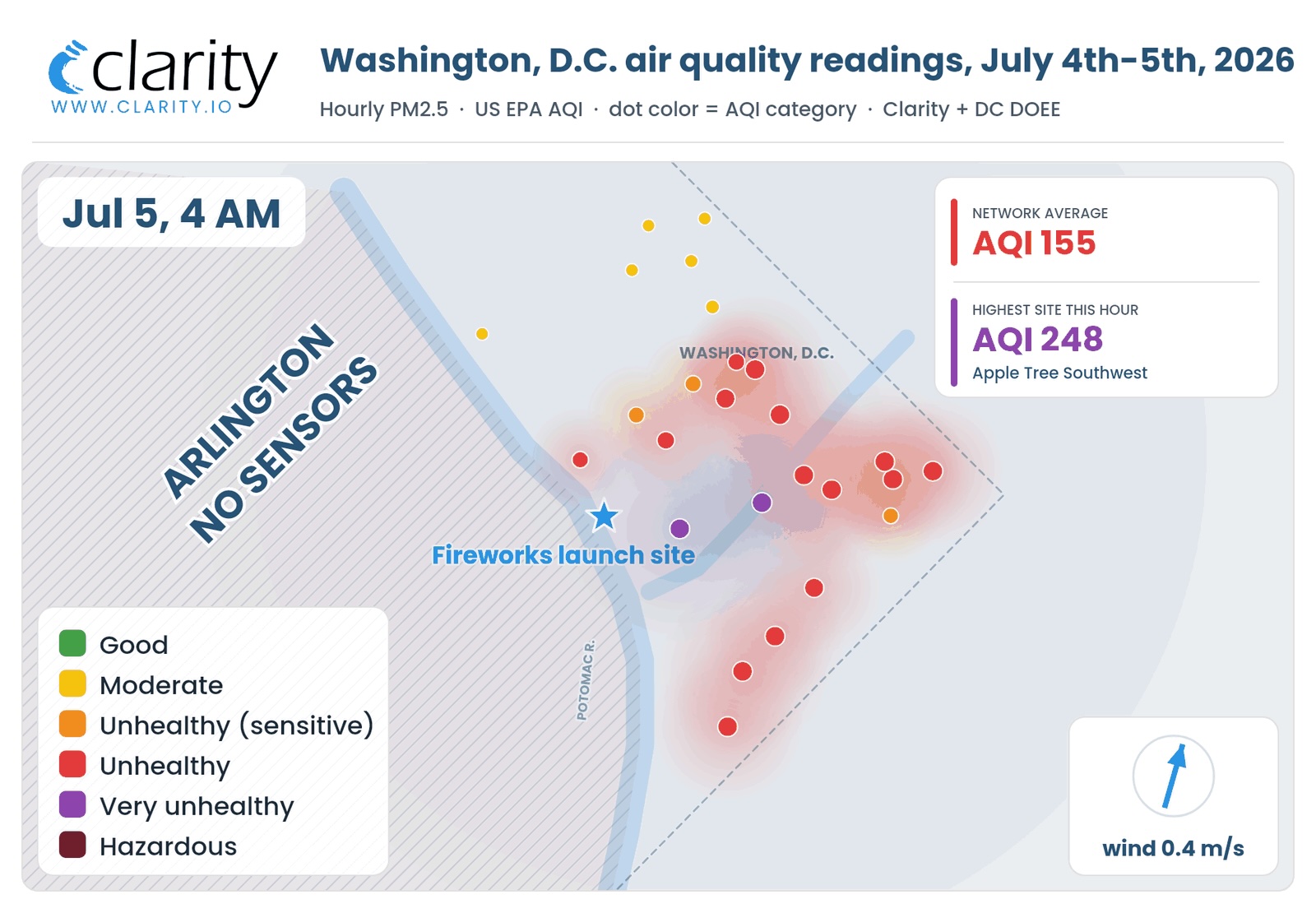
- Air quality impacts varied significantly across neighborhoods, with pollution levels differing by more than a factor of five depending on location.
"Our mission is to help communities better understand the air they breathe through transparent, scientifically rigorous data," said David Lu, CEO and co-founder of Clarity Movement and a TIME100 Climate honoree. "Freedom 250 provided a unique opportunity to study how a large-scale fireworks display, alongside broader July 4 celebrations across the city, affects air quality. By combining our network of air quality sensors with real-time particulate analysis, we're able to provide one of the most comprehensive analyses to date of how these events impact the air residents breathe."
The report found that while air quality across Washington, D.C. was in the EPA’s Moderate category prior to the fireworks, pollution began increasing throughout the evening before continuing to rise overnight as July 4 fireworks activity continued across the city, including the Freedom 250 display. Network-average PM2.5 concentrations peaked at 4:00 a.m. on July 5, before gradually declining back into the Moderate range by 9:00 a.m. The analysis also found that even neighborhoods far from the launch site experienced degraded air quality, demonstrating how fireworks smoke spread across the city rather than remaining concentrated near the National Mall.
“Data allows us to move beyond assumptions,” added Lu. “Rather than guessing how a major event affects air quality, we can measure where pollution travels, how long it lingers, and how communities across a city are impacted. That’s the kind of information that helps residents, researchers, and policymakers make better-informed decisions.”
The analysis is based on data collected from the Washington, D.C. Department of Energy and Environment’s network of Clarity air quality sensors, and provides one of the most detailed measurements to date of how a large-scale fireworks display affects urban air quality.
The report includes:
- Executive summary of the findings
- Hour-by-hour air quality analysis
- Citywide sensor network visualizations
- Neighborhood-level pollution maps
- EPA AQI analysis
- Methodology and quality-control process
- Interactive charts illustrating how pollution spread and dissipated across Washington
You can download the full report here.
About Clarity Movement
Clarity Movement builds advanced air quality monitoring technology that helps governments, researchers, businesses, and communities better understand pollution through hyperlocal environmental data. Clarity's sensor networks operate in cities around the world, delivering real-time air quality insights that support public health, climate research, and environmental decision-making.
Media Contact:
Mary Elkordy
Phone: 347-906-2514
Email: mary@elkordyglobal.com