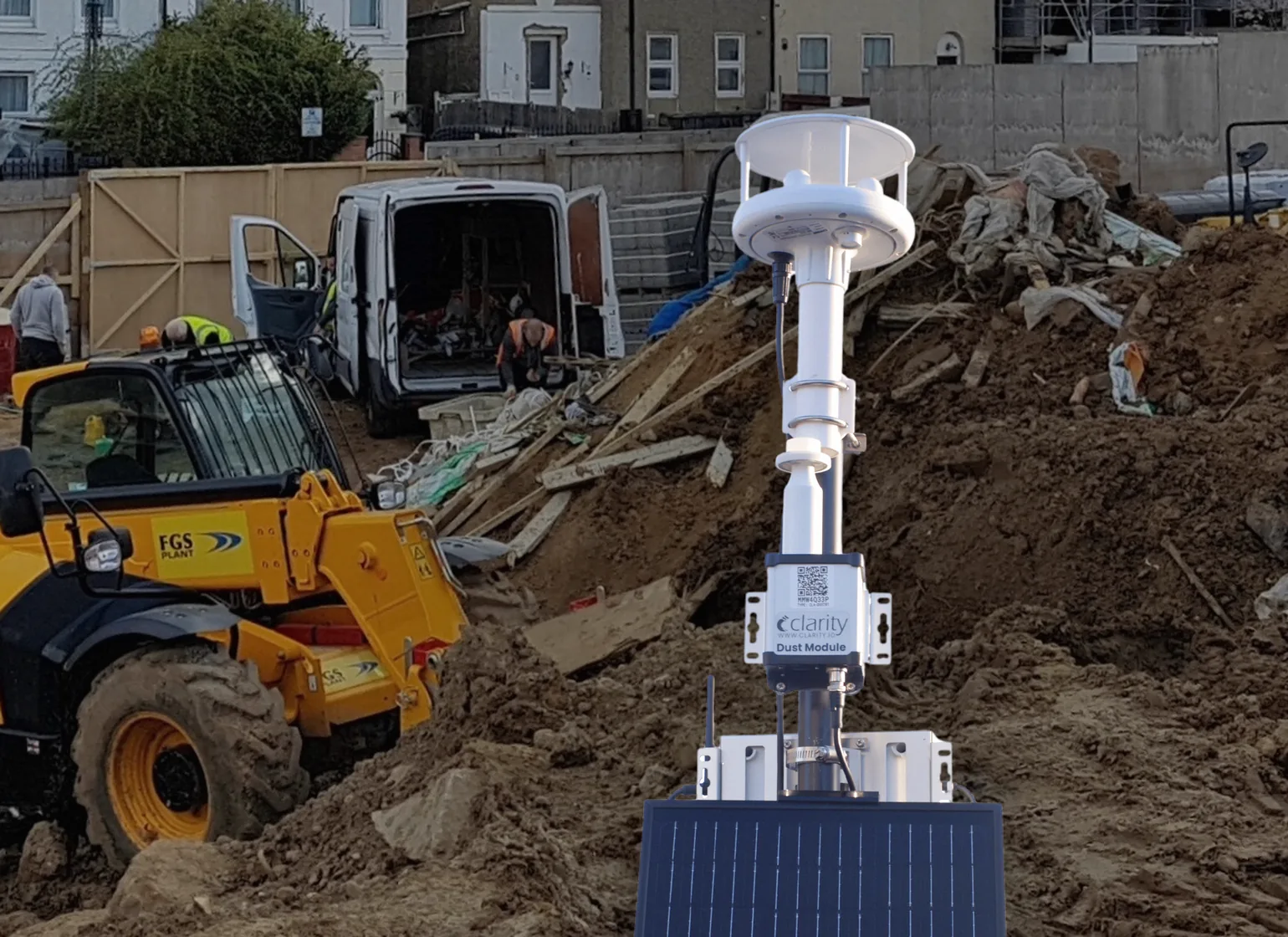
The only low-cost sensor MCERTS-certified for elevated dust
Construction Dust Monitoring in the UK
Real-time PM10 monitoring for UK construction and demolition sites, built around Institute of Air Quality Management (IAQM) guidance. Clarity Movement's Dust Module is the only low-cost sensor with MCERTS certification for elevated dust, so it reads accurately where other sensors under-read and alerts your team before PM10 reaches your site action level.
Construction dust PM10 monitoring built for UK requirements
Demolition, earthworks, construction, and trackout all release PM10. For medium and high-risk sites, local planning authorities increasingly expect a dust management plan backed by continuous, real-time PM10 monitoring at the site boundary, with a baseline period before works begin.
From basement excavations in London to developments in Surrey, Sussex, and Newcastle, Clarity helps contractors turn a dust risk assessment into a monitoring record that stands up when the local authority asks for it.
- Support planning conditions and dust management plans with continuous PM10 records you can export
- Act on IAQM site action level alerts at 190 µg/m³ or your own site-specific trigger
- Reduce statutory nuisance complaints by catching dust events before neighbours do
- Protect sensitive receptors with monitors placed upwind, downwind, and near homes and schools
The only low-cost sensor MCERTS-certified for elevated dust
Every other indicative monitor is certified at typical ambient levels. The Clarity Dust Module was certified on field data that reached nearly twice the IAQM site action level of 190 µg/m³ (one-hour mean), the trigger at which the site manager should be alerted.

Indicative data supports alerting and dust management. It does not replace the reference monitoring used to report against air quality limit values.
Trusted by UK air quality leaders


Why UK contractors choose Clarity for construction dust monitoring
The only low-cost sensor certified for elevated dust
The Dust Module is the only low-cost sensor with MCERTS certification for elevated PM10, with a performance range that covers the IAQM site action level rather than ambient background alone.
Alerts before a complaint
Site managers are notified when PM10 approaches 190 µg/m³ or your site-specific trigger, so dust suppression starts before neighbours notice.
Live on day one
Cellular connectivity and an external solar power option mean monitors go up on hoarding without waiting for mains power or Wi-Fi.
Evidence for planning
Continuous, exportable PM10 records support your dust management plan and the conditions attached to your planning consent.
Proven in London
More than 400 Node-S sensors already run the Breathe London network with the Greater London Authority and Imperial College London.
Sensing-as-a-Service
One subscription covers hardware, calibration, data, and support, and the monitors move with you to the next site.
Real-time construction dust monitoring: Clarity vs. typical low-cost sensors
Two questions decide it: will the monitor catch a dust event, and will the data stand up when the local authority asks for it?
| What UK sites ask | Clarity Node-S with Dust Module | Typical low-cost PM sensors |
|---|---|---|
| MCERTS for elevated PM10 | The only low-cost sensor MCERTS-certified for elevated PM10, with a performance range of 0 to 374 µg/m³ (hourly) | Uncertified, or certified only at ambient concentrations well below the IAQM action level |
| Accuracy at elevated dust levels | Field tested against heated beta attenuation reference monitors at hourly PM10 up to 374 µg/m³ | Calibrated at background levels, so coarse dust is often under-read |
| Coarse particle sizing | Measures PM10 directly, with enhanced optics that detect changes in particle size distribution | Infers PM10 from PM2.5 and cannot reliably size particles above about 1 µm |
| Damp UK weather | Heated inlet dries the sample before it is measured | No heated inlet, so humidity and fog inflate readings |
| Real-time alerts | Threshold alerts at 190 µg/m³ or your site-specific trigger, sent to site managers | Limited or no alerting |
| Siting on a live site | Cellular connectivity and an external solar power option, so monitors mount on hoarding or a pole without mains power or Wi-Fi | Often needs mains power and Wi-Fi |
| Pollutants covered | PM10 from the Dust Module, PM2.5 and NO₂ from the Node-S, plus the Wind Module and Black Carbon Module as Add-On Modules | Mostly PM2.5 only |
| Support | Sensing-as-a-Service with calibration, remote device health, and expert support included | Self-managed |
Real-world construction dust monitoring projects
Two deployments that show how Clarity networks run on live construction sites and at scale across the UK.
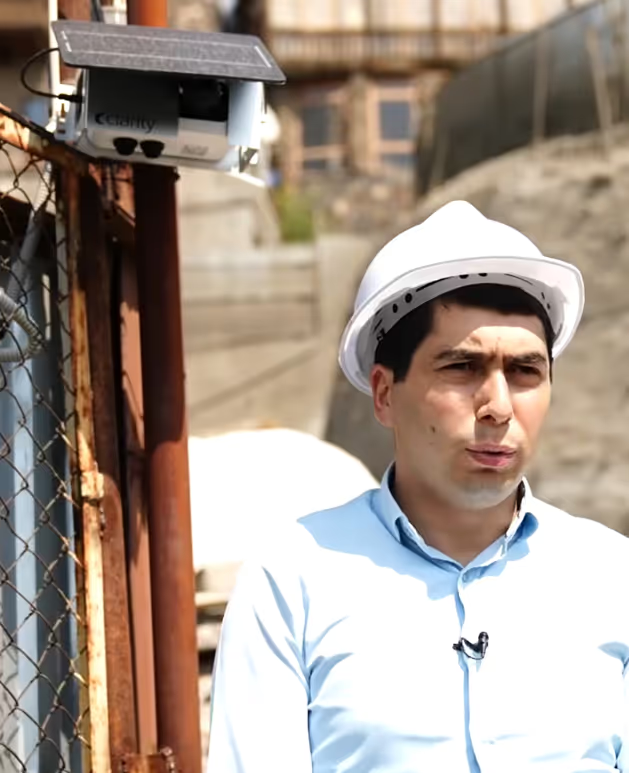
Yerevan: real-time air quality monitoring on every major construction site
When Yerevan's City Council made air quality monitoring compulsory for high-risk construction projects, the Technology Management Center of Yerevan City chose Clarity. Around 170 Node-S sensors now run across the city, and every major construction site carries at least two.
Threshold alerts flag dust spikes so inspectors can respond, data feeds the city's GIS platform through our API, and a public dashboard lets residents check air quality in their district at any time.
“The Clarity dashboard and air quality alert system are intuitive and convenient for our staff, which has made their day-to-day operations much easier.”Gorik Avetisyan, Deputy Head of the Environmental Protection Department, City of YerevanRead the full customer story →
Breathe London: hyperlocal air quality data across the capital
Co-funded by the Greater London Authority with philanthropic support from Bloomberg Philanthropies and C40 Cities, and run by Imperial College London's Environmental Research Group, Breathe London uses Clarity Node-S sensors to measure PM2.5 and NO₂ across all 33 boroughs.
Solar-powered sensors mount on lamp posts and buildings without mains power, and every device is collocated with London's reference network before deployment. It is the same siting flexibility and data discipline a UK construction boundary needs.
“The Clarity Node-S is light, it has a small solar panel, and it's reliable. We can put them anywhere.”Andrew Grieve, Senior Air Quality Analyst, Imperial College LondonRead the full customer story →

Trusted by air quality teams in London and beyond


Hyperlocal pollution data is vital to assess the air quality, to help spread awareness, and to start making change. As soon as people understand the air they're breathing, they can start to make real positive change.


We use our reference network with collocated Node-S devices to make estimates of the interactions between the pollutants. This also helps us to make adjustments for the weather conditions like relative humidity, how damp is the air, how hot is the air.


“I am delighted that Londoners will now have access to real-time, accurate air quality data for their area from more than 400 monitoring sites. This will improve awareness and help people reduce their exposure to polluted air and better target efforts on improving air quality at a local level.”


"The Clarity Node-S is light, it has a small solar panel, and it's reliable. We can put them anywhere. All of those things combined mean it is super easy for communities to put them up by themselves."
Construction dust monitoring equipment
Start with the Node-S and the MCERTS-certified Dust Module, then add what your dust management plan calls for.
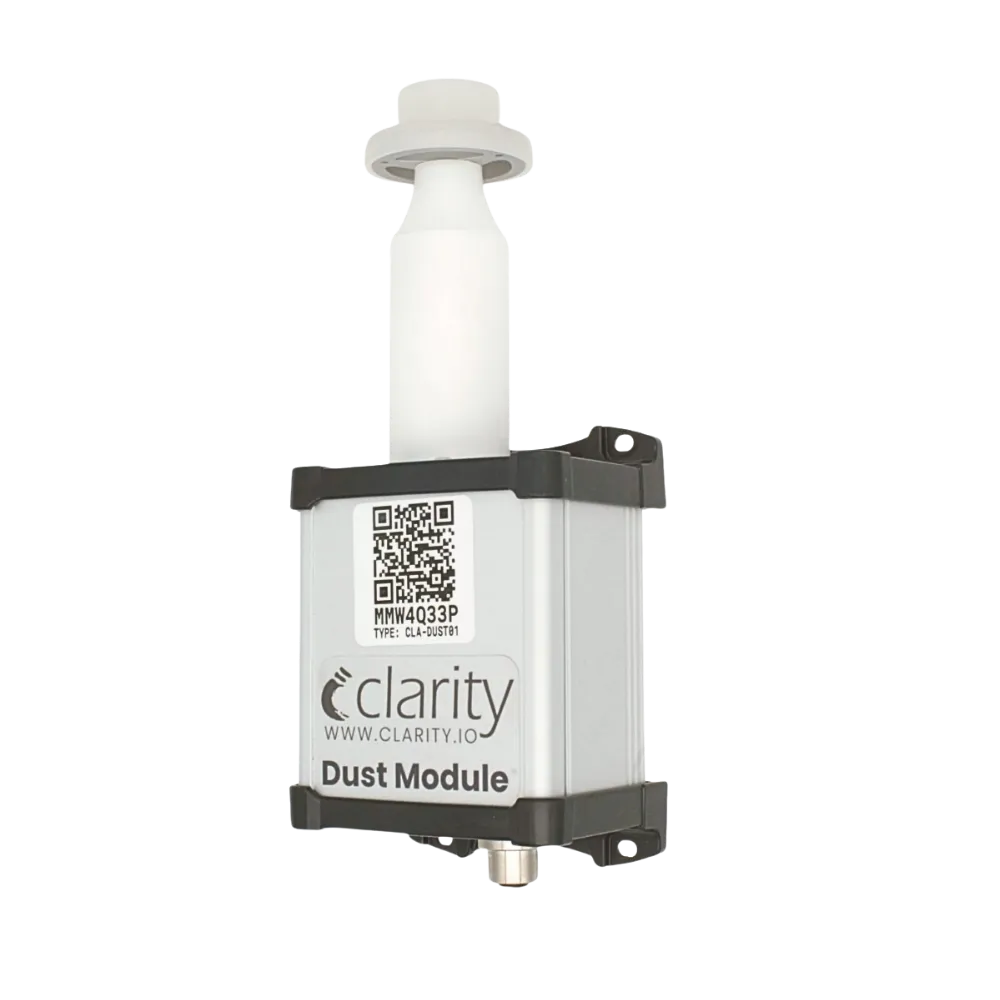
Clarity Dust Module
Measures PM10 directly by optical light scattering, with enhanced optics for coarse particles and a heated inlet that dries the sample in damp weather. The only low-cost sensor MCERTS-certified for elevated dust, with a PM10 performance range of 0 to 374 µg/m³. Connects to the Node-S and runs on an external power system, with a solar option for sites without mains power.
Learn more →
Clarity Node-S
The solar-powered, cellular-connected base unit that powers and connects the Dust Module. Measures PM2.5 and NO₂ in its own right, holds its own MCERTS certificate, and mounts on hoarding or a pole in minutes.
Learn more →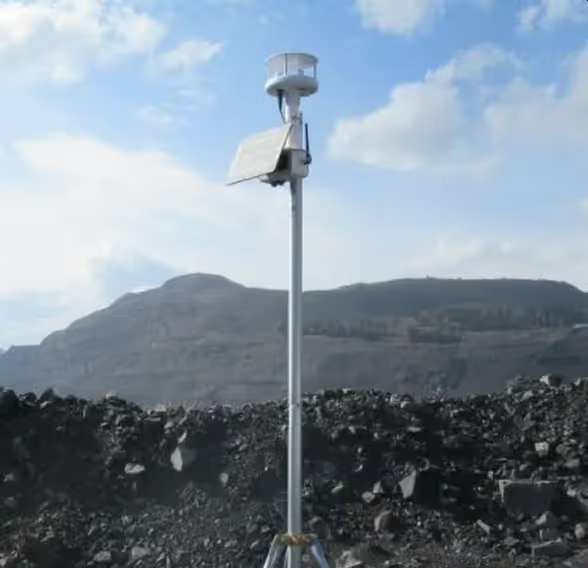
Wind Module
Wind speed and direction show whether a PM10 spike came from your works or from an upwind source, such as a regional pollution episode or a neighbouring site.
Learn more →
Dashboard and alerts
Set alerts at the IAQM action level or your own trigger, export PM10 records for your local authority, and pull every measurement through the API.
Learn more →Not sure how many monitors you need?
We size a network around your dust risk assessment, site boundary, and sensitive receptors, and quote it as one subscription.
Construction dust monitoring UK: FAQ
There is no single national law that requires it. Local planning authorities commonly require it through planning conditions and a dust management plan, especially for medium and high-risk sites, and in London the Mayor's guidance on the control of dust and emissions during construction and demolition sets clear expectations for monitoring. Dust can also be treated as a statutory nuisance under the Environmental Protection Act 1990, so a continuous monitoring record protects you on both fronts.
The Institute of Air Quality Management (IAQM) recommends a generic site action level of 190 µg/m³ of PM10, measured as a one-hour mean. Above it, an alert should go to the site manager so the cause can be investigated and controlled. Some sites set lower, site-specific triggers, and the Clarity Dashboard supports either.
The IAQM approach rates demolition, earthworks, construction, and trackout as low, medium, or high risk, based on the scale of the works and the sensitivity of nearby receptors. Low-risk sites may only need visual inspections. Medium and high-risk sites are typically expected to run continuous, real-time PM10 monitoring at the boundary, ideally with a baseline period before works start.
The IAQM position statement cautions that many low-cost sensors under-read PM10 at elevated concentrations and says MCERTS certification alone is not sufficient for this application. Buyers should ask for independent evidence of performance at high dust levels. The Clarity Dust Module was certified by CSA Group on field data with hourly PM10 up to 374 µg/m³, tested against heated beta attenuation reference monitors, so its certified performance range covers the IAQM action level.
Most sites run a Clarity Node-S with the Dust Module at the boundary, placed upwind and downwind of the works and near sensitive receptors such as homes and schools. A Wind Module helps separate site dust from background pollution, and a Black Carbon Module tracks diesel plant and non-road mobile machinery. Our team sizes the network around your dust risk assessment.
Yes. We support construction sites across the UK, including London, Surrey, Sussex, and Newcastle. Monitors use cellular connectivity and can run on an external solar power system, so they can be deployed on hoarding or a pole without mains power, and our team supports setup and device health remotely.
Cost depends on the number of monitors, the modules you need, and how long the works run. Our Sensing-as-a-Service subscription bundles hardware, calibration, cellular data, software, and support into one annual fee, so there is no large upfront purchase, and the monitors move with you to the next site. Request a quote for a price based on your site.
Check four things: MCERTS certification with a performance range that covers 190 µg/m³, independent evidence of accuracy at elevated dust levels, real-time alerts that reach the people who can act, and how easily the data can be exported and shared with your local authority. Ask whether the monitor has a heated inlet for damp weather and whether calibration and support are included in the price.
Construction dust monitoring resources
The certification, the webinar, and the guide behind this page.
Get a construction dust monitoring quote for your UK site
Tell us about your site and a Clarity air quality expert will scope a PM10 network around your dust risk assessment, site boundary, and programme. We reply within one business day.
- MCERTS-certified PM10. Performance range to 374 µg/m³, covering the IAQM action level.
- Alerts at 190 µg/m³. Or your own site-specific trigger, sent to the people who can act.
- Installed without mains power. Cellular connectivity and an external solar power option for hoarding and pole mounts.
Request a quote
Request a quote for a construction dust monitoring network today.
Prefer to talk? Talk to an air quality expert
Other use cases
The same boundary monitoring approach, applied to other sources of dust and emissions.