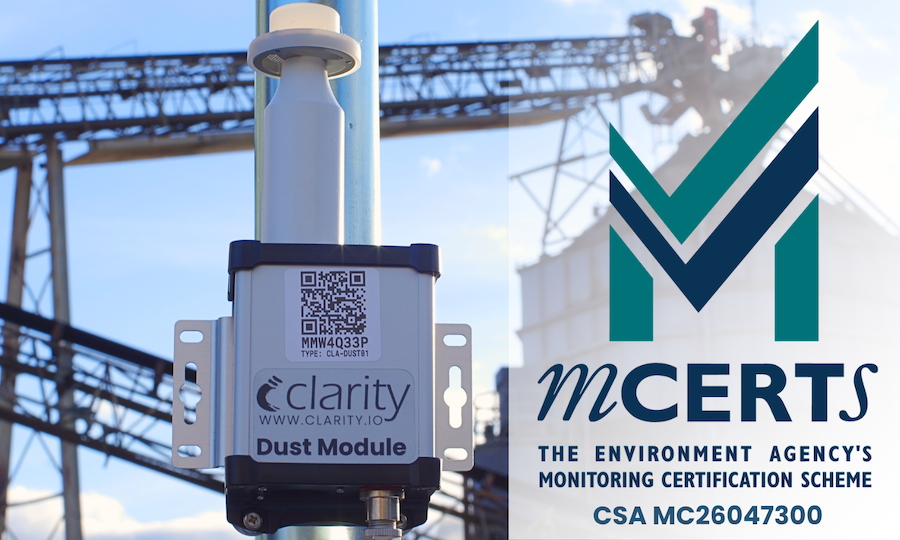
Clarity Dust Module becomes the first indicative monitor MCERTS certified for construction-level PM10
Clarity Movement's Dust Module has received MCERTS product certification from CSA Group, the body that operates the scheme on behalf of the Environment Agency. Certificate CSA MC260473/00, issued on 15 September 2026, covers PM10 measured by the Dust Module and PM2.5 measured by the Node-S, with a certified performance range for PM10 of 0 to 374 µg/m³ based on the hourly concentrations encountered during field testing.
The Node-S already held MCERTS certification for PM2.5 and PM10 at ambient concentrations. What makes this certification different is that testing was performed under elevated PM10 concentrations.
The Dust Module was field tested at a site where hourly PM10 regularly reached the dust levels typically found at construction, demolition, quarry, and industrial fencelines, and the certificate records those conditions: hourly PM10 up to 374 µg/m³, 24-hour PM10 up to 203 µg/m³, and, in CSA Group's words, "elevated PM coarse concentrations were frequently observed during the field testing."
To our knowledge, this is the first device to be certified specifically for elevated PM10 concentrations. This means the Dust Module is the first 'low-cost-sensor' that is MCERTS certified specifically for PM10 that meets and addresses most of the points from the Institute of Air Quality Management (IAQM) position statement from late 2025. For anyone responsible for a dust monitoring plan in the UK, that distinction matters more now than it did a year ago.
Why an ordinary MCERTS certificate is no longer sufficient for dust monitoring
MCERTS is the Environment Agency's environmental monitoring certification scheme. Its standard for Indicative Ambient Particulate Monitors (IAPM) tests a monitor in the field against a reference instrument and certifies it if measurement uncertainty stays within 50%. Until recently, that field test always happened in typical ambient air, usually at an urban background location, and certificates carried a stated measurement range, but that changed in 2025.
On 1 July 2025, CSA Group published MCERTS Product Certification Bulletin PC4. It clarified that an indicative MCERTS certificate only covers "the composition and magnitude that the sensors experience during field testing," and that indicative monitors "are not suitable for use in environments where PM10 concentrations are above those typical in ambient air, unless demonstrated to perform in these environments."
The bulletin names fenceline monitoring at construction, demolition, waste, and industrial sites as examples. It withdrew the stated certification ranges from every IAPM certificate, and it opened a route for manufacturers to extend the scope of certification by submitting field test evidence from other types of locations.
In September 2025, the Institute of Air Quality Management (IAQM) published a position statement on low-cost sensor systems for PM10 near demolition and construction sites. IAQM guidance recommends a generic site action level of 190 µg/m³ PM10 as a one-hour mean, above which an alert should go to the site manager.
IAQM stated that some MCERTS-certified low-cost sensors under-report PM10 as concentrations approach that level, so exceedances can go undetected and dust management actions are never triggered. The position statement is direct on the point: "MCERTS certification alone is not sufficient to demonstrate that LCS systems are suitable for this application."
The position statement also explains the root cause. Most low-cost PM sensors were calibrated on ambient data below the action level, and the underlying optical sensors cannot reliably discriminate particles larger than about 1 µm, which is where most construction dust sits. IAQM asked manufacturers to publish independent evidence of performance at elevated PM10, and asked users to seek that evidence before relying on a system.
What makes the Dust Module different from other low-cost sensors
Most low-cost PM sensors, including the Plantower sensor inside the Node-S and the Sensirion and Plantower sensors inside many competing monitors, were designed to measure fine particles. Field studies (Molina Rueda et al., 2023) have shown that these sensors cannot reliably size particles larger than about 1 µm and tend to report PM10 as a scaled version of PM2.5. On an urban street with typical background levels of PM10, that is a tolerable simplification. On a demolition site, where most of the mass is coarse dust between 2.5 and 10 µm, it means the sensor can miss the very particles the monitoring is there to catch.
The Dust Module is a different instrument. It measures PM10 directly by optical light scattering, with enhanced optics that detect changes in the particle size distribution rather than inferring coarse mass from fine mass. A dedicated heated inlet dries the sample stream before measurement, removing the humidity and fog artifacts that inflate readings from unheated sensors, and its measurement range of 0 to 10,000 µg/m³ at 1 µg/m³ resolution covers any action level a site would apply. The Dust Module connects to the Node-S and runs on the same solar power and cellular connectivity, so the field footprint is unchanged.
Those two design choices answer the two concerns IAQM raised: size discrimination above 1 µm, and performance in humid or high-dust conditions without a heated inlet.
What the Dust Module certification covers
For certification, two Node-S with Dust Module systems ran from 10 October 2025 to 18 January 2026 in Calexico, California, collocated with Met One 1020 heated beta attenuation monitors as the reference method. Calexico sits on the US-Mexico border in the Imperial Valley and regularly experiences elevated coarse dust from unpaved roads, agriculture, and desert wind.
The certificate records the conditions the monitors were exposed to. Hourly PM10 ranged from 0 to 374 µg/m³, nearly twice the IAQM action level of 190 µg/m³ and well above the 150 µg/m³ that MCERTS treats as the upper end of the typical range for indicative monitors. Twenty-four-hour PM10 ranged from 4 to 203 µg/m³, temperatures from 8 to 36 °C, and relative humidity from 7 to 98%. Bureau Veritas carried out the test and reported the results in April 2026 (report AIR30632926).
The results against the MCERTS criteria:
- Certified performance range for PM10 of 0 to 374 µg/m³ (hourly average), stated on the face of the certificate.
- PM10 measurement uncertainty of 38% across all valid data and 40% for the subset at or above 30 µg/m³, against a limit of 50% for indicative instruments.
- Intra-instrument uncertainty (agreement between the two Dust Modules) of about 2 µg/m³, against a limit of 5 µg/m³.
- The certified configuration uses the Dust Module's factory PM10 calibration, with site-specific calibration available as an alternative through our standard collocation procedure.
- Maintenance interval of at least two years, with no routine field maintenance and an automatic alarm if performance degrades.
The measurement range of the Dust Module is 0 to 10,000 µg/m³ at 1 µg/m³ resolution, well above any action level a site would apply.
MCERTS certification at elevated concentrations does not turn the Dust Module into a reference instrument. It is an indicative certification with the 50% uncertainty class that applies to all IAPM, and indicative data cannot be used for compliance reporting against air quality limit values.
The job of a construction dust monitor is different. It has to detect an exceedance of the site action level reliably and in real time so that dust suppression happens. That is what the Dust Module was tested and certified to do.
What this means for a dust monitoring plan
The IAQM position statement lists eight recommendations for anyone using low-cost sensors near a construction site. The Dust Module certification addresses the ones that have been hardest to satisfy.
Detecting elevated PM10 (Recommendations 1 and 2).
IAQM asks that any monitoring system be able to identify elevated PM10 concentrations and meet the objectives of the monitoring. The Dust Module was certified on a dataset that included hourly PM10 up to 374 µg/m³, nearly twice the 190 µg/m³ action level, and its certified performance range covers the full span up to that value.
Independent evidence (Recommendations 3 and 6).
IAQM asks users to collect independent evidence and asks manufacturers to publish it. The Bureau Veritas test report and the CSA Group certificate are that evidence, and we publish additional collocation data in our collocation results library.
Heated inlet and known sensor configuration (Recommendations 4 and 5).
IAQM asks users to confirm which sensor is used, whether it has a heated inlet, and what algorithms adjust the data. The Dust Module has a dedicated heated inlet, and the certificate lists the exact sensor, firmware, and algorithm versions covered.
Keeping the generic action level (Recommendation 8).
Where a sensor has not been validated at elevated concentrations, IAQM suggests lowering the site-specific action level to stay within the sensor's validated range. With a system certified at elevated concentrations, sites can apply the 190 µg/m³ generic action level as the guidance intends.
The Dust Module has the ability to run on solar power with cellular connectivity, so it can be placed at upwind and downwind fenceline positions without mains power or trenching. Alerts against the action level are configured in the Clarity Dashboard, and every measurement is available through the API for monitoring reports.
Availability
The Dust Module is available now as an add-on to the Node-S air quality sensor, and most existing Node-S deployments in the field can add the module.
If you are preparing a dust monitoring plan for a construction, demolition, quarry, or industrial site, talk to our team about how the Dust Module fits. You can also download the MCERTS certificate and the Dust Module specification sheet.
We will walk through the certification results and take questions in a live webinar on a TBD date in October. You can pre-register here to be added to the webinar when registration opens.