.png)
Image provided by Adil Sattarov via Unsplash.
TL;DR: Ultrafine particles (UFPs) are a type of particulate matter. With diameters of 0.1 microns or smaller, ultrafine particles can penetrate deep into the bloodstream and even the brain. Because their mass is too small to measure practically, ultrafine particle monitoring instead tracks particle number concentration (PNC). Ultrafine particle pollution is often more pronounced near traffic, industrial areas, and other combustion sources. While most countries lack regulations, tracking UFP exposure can help protect public health.
What are ultrafine particles (UFP)?
Ultrafine particles are a kind of particulate matter. Particulate matter (PM) is a general term that refers to any kind of solid or liquid particles suspended in the air.
Particulate matter is categorized based on its size. For instance, PM10 refers to any particulates with a diameter of 10 micrometers or smaller. PM2.5, on the other hand, refers to any particulates with a diameter of 2.5 micrometers or smaller. Both PM10 and PM2.5 are significantly smaller than a grain of sand on the beach and are regulated by the U.S. EPA through the National Ambient Air Quality Standards.
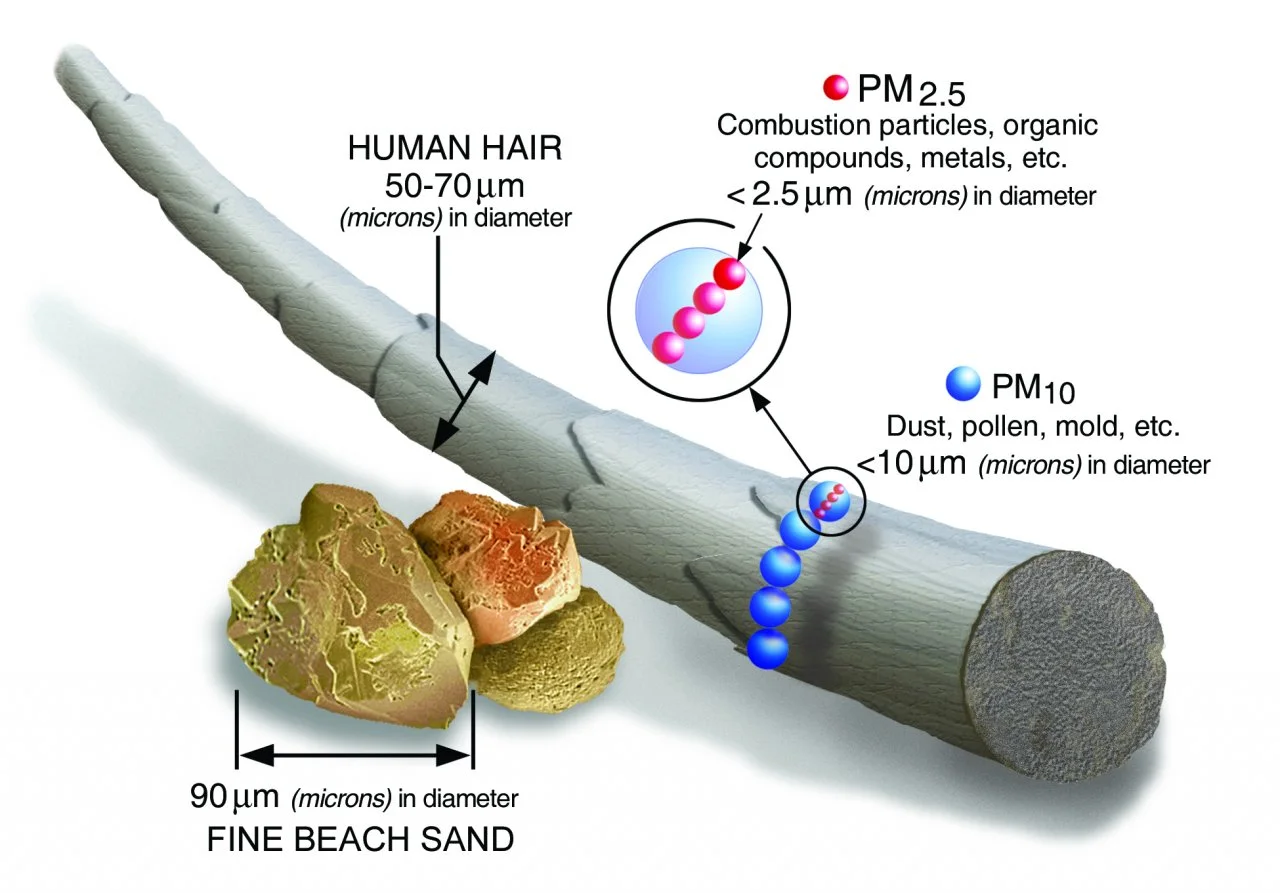
However, there is an even smaller kind of particulate matter: ultrafine particles (UFPs), also referred to as PM0.1. Ultrafine particles are 0.1 microns or smaller in diameter.
Why ultrafine particle monitoring matters
All particulate matter is harmful to human health. Yet smaller particles, such as PM2.5 and ultrafine particles, can bypass our body's natural defenses. UFPs are small enough to pass through lung tissue and enter the bloodstream, where they can circulate like oxygen molecules and trigger systemic oxidative stress, atherosclerosis, and endothelial dysfunction. UFPs are so small that they can even travel along the olfactory nerves to the brain, where they can cause cerebral and autonomic dysfunction. In fact, ultrafine particles can translocate to virtually all organs, causing adverse health effects.
UFPs cause more pulmonary inflammation than PM2.5 and are retained for longer inside the lungs. Exposure to ultrafine particles can cause coughing and worsen asthma, and has been linked to both diabetes and cancer. In utero exposure to UFPs increases the risk of low birth weight. The disease known as metal fume fever is likely caused by ultrafine particles in metal fumes, usually produced by welding.
A recent study published in the journal Cardiovascular Research (Oxford University Press, the journal of the European Society of Cardiology) estimated that 1.99 million deaths annually worldwide are attributable to ultrafine particle exposure. About half of these deaths are ostensibly caused by cardiovascular disease, with ultrafine exposure being the attributable risk factor. Children, pregnant women, and the elderly are more vulnerable to ultrafine particle exposure.
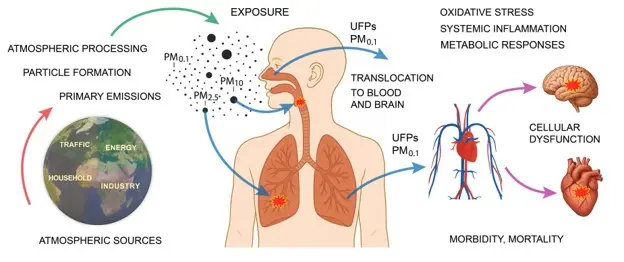
Reasons why UFPs should be monitored include:
- The need for more research to understand UFPs
- Negative health effects of UFPs
- Hotspot proximity, such as traffic and other UFP sources
What UFP monitoring measures
As particle size decreases, the numbers increase. This means that ultrafine particles are generally present in the air in greater numbers than larger PM.
UFPs disperse more rapidly in the atmosphere than larger particles, and UFPs often coalesce into larger particles over time. This means they generally do not travel long distances and are more sensitive to weather changes. Ultrafine particles are usually found near traffic and industrial hotspots.
The mass of UFP particles is negligible in comparison to PM2.5 and larger particles. This makes mass measurement, often used for PM2.5 and PM10, less useful for UFPs, which are better characterized by particle number and total surface area.
Particle number concentration (PNC) refers to the total number of aerosol particles in a given volume of air. In fact, PNC is often used as a proxy for UFPs, since most particles in the air are ultrafine. UFPs account for about 80 to 90% of the total particle number concentration in PM2.5, although this percentage can vary drastically.
How ultrafine particle monitoring works: Detect, measure, track
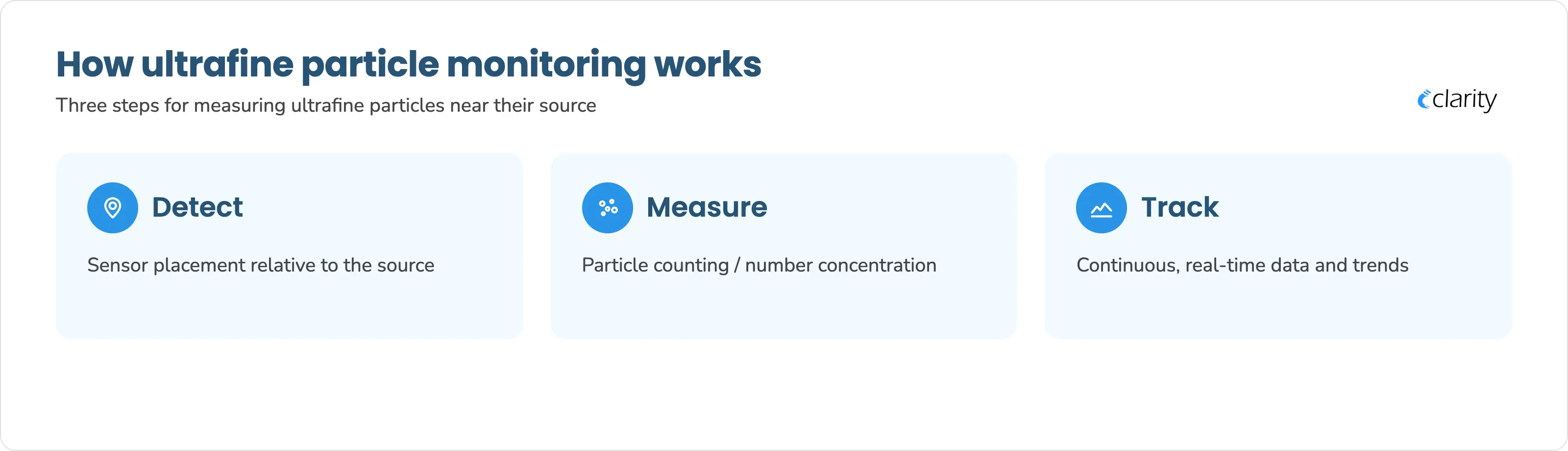
Ultrafine particle monitoring consists of three general steps:
- 1. Detect: Project managers must secure funding, select the most appropriate sensor type for their monitoring needs, and determine sensor placement. Since UFPs tend to remain near their sources before dispersing into the atmosphere, it makes sense to monitor hotspots and roadsides. Certain sensors require external power and Wi-Fi, which can affect sensor placement.
- 2. Measure: Once sensors are in place, project managers should obtain accurate information on ultrafine particle number concentrations. Ideally, sensors should be part of a sensor network, enabling better spatial resolution and identification of air pollution hotspots.
- 3. Track: Real-time air quality data allows project managers to observe air pollution trends over time. This valuable information enables policymakers to make appropriate legislation to reduce UFPs and empowers the public to make the most informed decisions to protect themselves.
Where UFP pollution comes from, and who monitors it
UFP air pollution results from combustion, with 75% of global exposure originating from fossil fuels. Sources include traffic exhaust, trash burning, incense, domestic wood burning, smoking, cooking, energy production, power plants, industry, and more. Ultrafine particles can consist of black and organic carbon, nitrates, sulfates, trace metals, and potentially toxic elements.
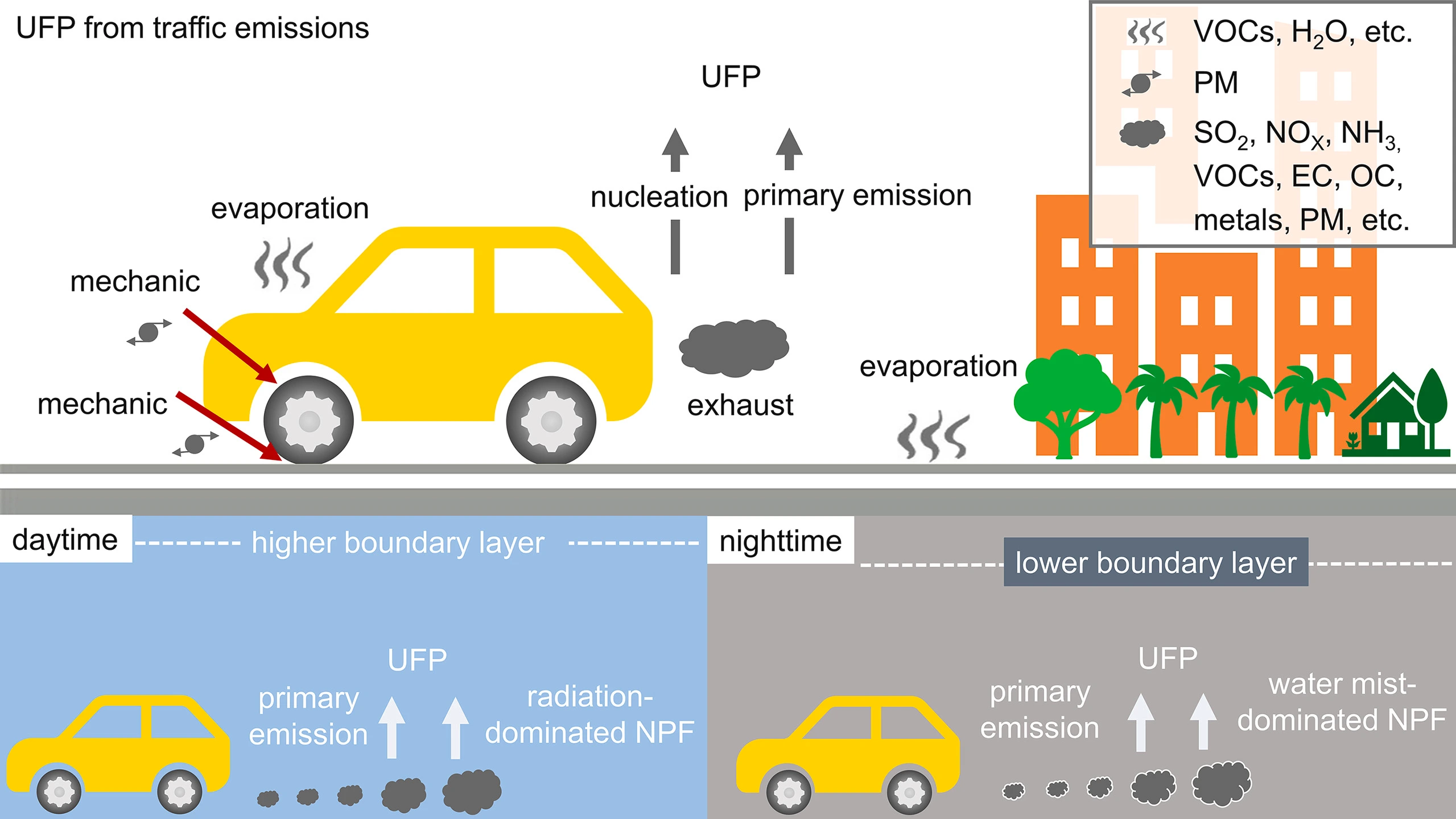
Two of the main sources of UFPs in urban areas are traffic emissions and nucleation. Significant UFP emissions are often found near traffic curbsides, where they are frequently more than ten times higher than background concentrations.
Nucleation is the first step in new particle formation. New particle formation (NPF) refers to the process in which trace vapors cluster together in the air to form very tiny particles, such as UFPs. Ultrafine particle precursors include NOx, SO2, VOCs, NH3, and primary organic aerosols (POA).
| Source | Why it's monitored | Who monitors |
|---|---|---|
| Traffic & near-road | Combustion / diesel exhaust hotspots | Cities, agencies, non-profits, communities, schools, etc. |
| Airports & aviation | Elevated UFP concentrations near and downwind of airports. | Academic researchers, local governments, companies, and community groups. |
| Ports & logistics | Elevated UFP concentrations can be found in areas surrounding ports. | Community groups, local governments, companies, etc. |
| Industrial manufacturing facilities | Certain industrial activities, such as welding or blast furnace operation, can result in significant UFP air pollution. | Companies and communities |
Emerging standards and regulatory demands
Under the new EU Ambient Air Quality Directive 2024/2881, ultrafine particles are included in ambient air monitoring. The World Health Organization (WHO) has issued technical recommendations and guidelines, encouraging countries to monitor UFPs and implement related standards. The WHO and the European Union classify UFPs as a “contaminant of emerging concern.”
The aforementioned Cardiovascular Research study found that an annual limit value of 5,000 particles per cubic centimeter could potentially reduce global excess mortality from UFPs by roughly 45%.
As of now, there is a lack of international standards and national reporting systems in most countries. Developing standards for UFPs is difficult because UFP measurement is not yet standardized, with different methods and protocols in use that are challenging to reconcile. Moreover, personal exposure levels can vary widely, and the effects of UFPs may not be easily recognized, leading to their being overlooked.
Modern ultrafine particle monitoring
Although there are generally no regulatory standards for UFPs, monitoring ultrafine particles helps communities, governments, and organizations better understand exposure levels and UFP health effects. Monitoring plays an important role in keeping people informed and safe from dangerous levels of air pollution.
UFP monitoring methods include:
- Condensation particle counters (CPCs): The CPCs condense a fluid onto particles, causing them to grow to a size that is detectable by optical scattering. Optical scattering occurs when particles pass through a light source, scattering the light and allowing a sensor to count and size them based on the intensity of the scattered light.
- Scanning mobility particle sizers (SMPS): These generally measure particle size by applying a positive charge to the particles, which attracts them to a negatively charged rod. This method uses a radioactive source.
- Diffusion charging instruments: In this method, ions attach to particles via diffusion, thereby imparting an electric charge to the particles. Then, the charged particles are captured on a filter, where the instrument measures their total charge.
Although Clarity does not currently offer UFP monitoring, discover our air quality sensor solutions for particulate matter and other air pollutants. Partner with us to secure clean air and healthier communities.