Wildfire
Article
October 2, 2026
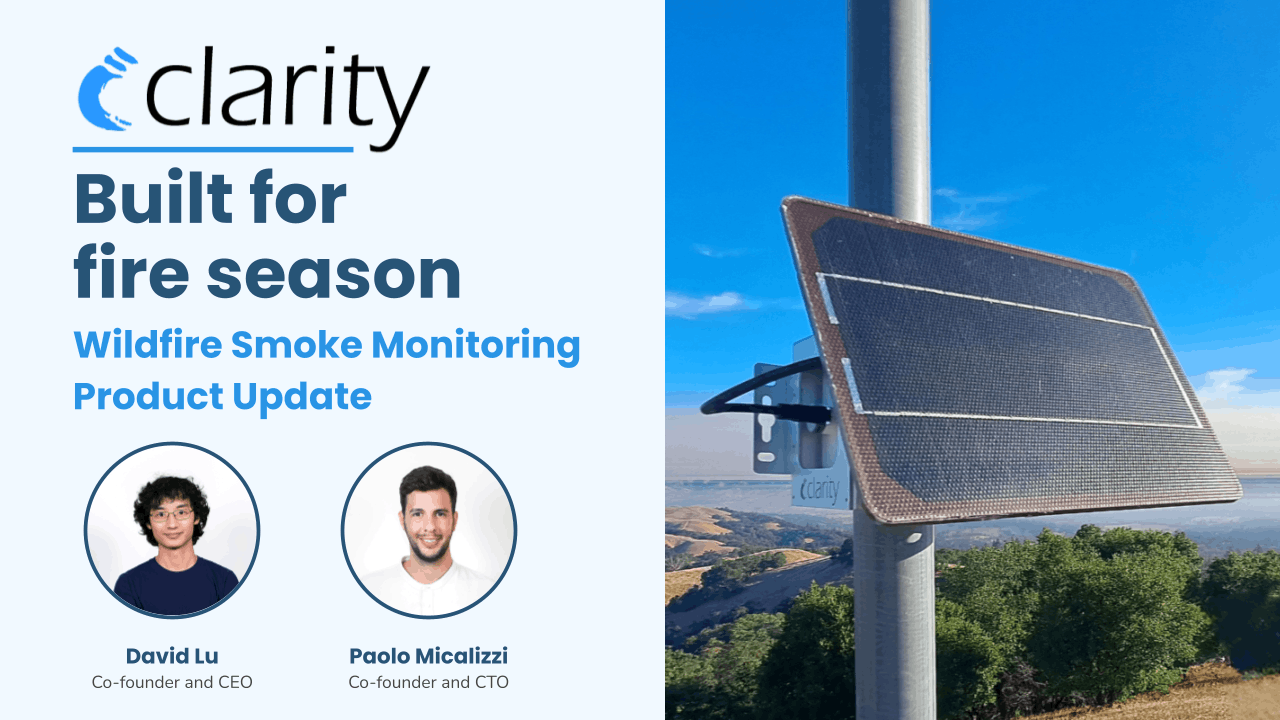
Webinar Recap | Built for fire season: Wildfire smoke monitoring product update Clarity's CEO and CTO share new wildfire smoke monitoring features, including satellite connectivity, an extended CO range, and expanded public data sharing.
Article
Why are there so many wildfires right now? How frequently do wildfires occur?An examination of wildfire seasons in North America over the past decade reveals how climate change and human activity are driving more frequent and intense fires.
Article
Clarity releases v2.1 PM2.5 Global Calibration with improved performance during wildfires and high-pollution events Clarity’s Lab Team is excited to release version 2.1 of our PM2.5 Global Calibration! v2.1 improves upon the powerful v2 PM2.5 Global Calibration by increasing accuracy during high-pollution events. In this blog post, we explain how we developed this new calibration and share performance metrics that show a significant improvement in sensor accuracy, especially during periods with elevated pollutant concentrations.
Article
After the Wildfires: An Update on LA Air QualityAir quality has improved significantly since the LA fires began, and regular activities can be resumed. Yet, ash should be cleaned up by professionals and precautions may need to be taken near burn areas. Some toxic air pollutants may linger.
Article
How forest management reduces wildfire risks and protects park air qualityImplementing wildfire prevention strategies at the individual and agency levels, establishing resilient air quality monitoring networks, and understanding how severely wildfire and poor air quality impact our national parks can help preserve them.
Article
Why real-time air monitoring matters for 2026 wildfire seasonResearch shows that wildfire smoke can travel thousands of miles and, in addition to its well-known detrimental impacts on human health in the short term, may also have cumulative effects. Consequently, it is essential to establish a real-time air quality monitoring network to understand pollution exposure during wildfire season.
Article
Wildfires & climate change: what it means for air quality and human healthHow do wildfires affect air quality and human health? Explore the short- and long-term impacts of wildfire smoke on people, ecosystems, and the climate as fires grow more frequent and intense in 2026.
Article
How low-cost air sensors protect public health during wildfire seasonLow-cost sensors serve as a valuable tool during increasingly severe wildfire seasons to supply data and inform decision-making to protect public health.
Article
Wildfires and air quality: raising public awareness on pollutionFour individuals working to improve public and environmental health through air quality monitoring reflect on the catastrophic 2020 wildfire season in Clarity’s webinar.
Article
Navigating wildfire season during a global pandemicAdding a global pandemic to wildfire season contributes greatly to the threat, and many are looking for answers as the two crises collide.
Press Release
Blue Forest Conservation Partners with Clarity Movement Co. to Quantify the Public Health Impacts of Wildfire Smoke with Hyperlocal Air Quality Data Innovative non-profit focused on sustainable forest management will leverage high-resolution air quality data to quantify and monetize the public health impacts of wildfire smoke