
Image provided by Wim van 't Einde via Unsplash.
TL;DR: Sulfur dioxide is a regulated air pollutant that harms human health, ecosystems, and man-made structures. It also contributes to the formation of fine particulate matter. Continuous monitoring lets project managers pinpoint emission sources, identify health-risk areas, and see whether reduction strategies are working. Many SO2 sources also emit PM2.5, nitrogen oxides, carbon monoxide, and black carbon, so tracking those pollutants alongside SO2 gives a fuller picture of local air quality.
What is sulfur dioxide (SO2)?
Sulfur dioxide (SO2) is a colorless, nonflammable gas that is heavier than air. SO2 has a strong and unpleasant odor. It is made up of sulfur and oxygen, making it a member of the sulfur oxides (SOx) group. When fuel that contains sulfur, such as coal, diesel, or petroleum, is burned, SO2 is released into the atmosphere.
In the air, sulfur dioxide can transform into sulfate particles, a component of particulate matter (PM2.5). Particulate matter is another harmful form of air pollution.
Sulfur dioxide air pollution effects
Measuring sulfur dioxide matters because of its multifaceted negative effects. SO2 harms human health, the environment, and even man-made structures.
What sulfur dioxide monitoring measures
Sulfur dioxide is often measured in parts per million and parts per billion. This means that for every million or billion molecules of air, respectively, there are x number of SO2 particles. Sulfur dioxide may also be measured over an averaging time. An averaging time refers to the period over which air pollution data is averaged.
How sulfur dioxide monitoring works: Detect, measure, track
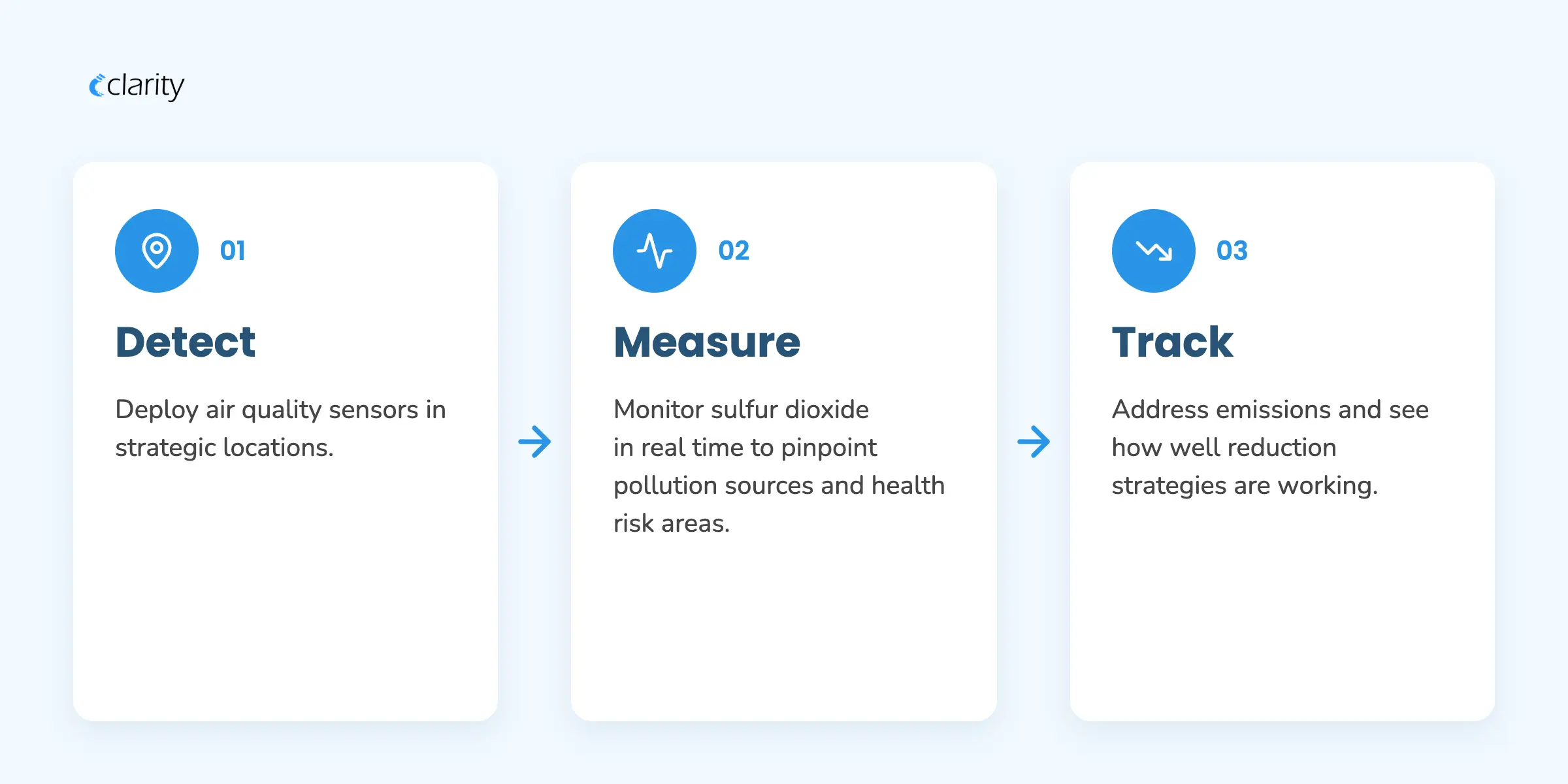
There are three steps to sulfur dioxide (SO2) monitoring:
- 1. Detect: Air quality sensors are deployed in strategic locations.
- 2. Measure: Sulfur dioxide concentrations are monitored in real time, allowing project managers to identify pollution sources and areas of health risk.
- 3. Track: Project managers can address sulfur dioxide emissions and monitor how effective pollution reduction strategies really are.
SO2 monitoring methods and systems
Sulfur dioxide monitors can use several different methods to measure SO2. Two common methods are UV pulsed fluorescence and electrochemical sensors.
- UV pulsed fluorescence: Monitoring instruments electronically excite SO2 using UV lamp radiation, making it fluoresce in the UV.
- Electrochemical sensors: Sulfur dioxide is oxidized, producing an electric current proportional to the SO2 concentration present.
Where sulfur dioxide comes from and who monitors it
As of 2020, anthropogenic sources in the United States emit roughly 1.8 million short tons of SO2 yearly. The biggest source of sulfur dioxide in the air is fossil fuel burning performed by power plants, artificial intelligence data centers, and other industrial facilities. However, there are many sources of SO2, including:
- Industrial processes, such as petroleum refining and metal processing
- Transportation, including diesel engines, ships, locomotives, and off-road equipment
- Volcanoes
- Commercial and institutional boilers
- Internal combustion engines

Sulfur dioxide standards and regulations
Sulfur dioxide is a criteria pollutant regulated under the Clean Air Act's National Ambient Air Quality Standards (NAAQS).
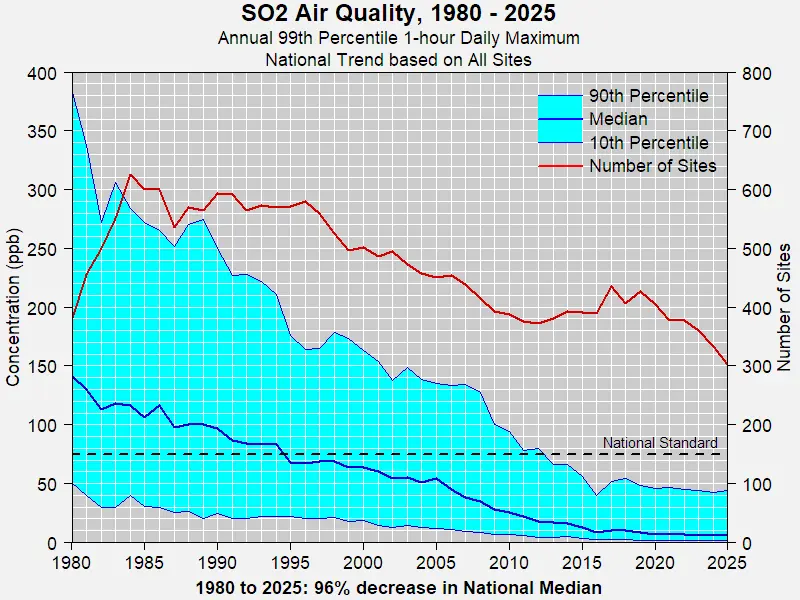
Primary standards exist to provide public health protection, whereas secondary standards exist to provide public welfare protection (non-health related benefits). The primary and secondary standards for SO2 under the Clean Air Act are shown in the table below, which has been adapted from the NAAQS Table.
Sulfur dioxide regulations and standards also include:
- State and regional standards
- Fenceline monitoring rules
- International standards
- World Health Organization global air quality guidelines
Monitor pollutants related to SO2 with Clarity’s air quality measurement equipment
Sulfur dioxide is a precursor to particulate matter (PM2.5) air pollution. Many SO2 sources also produce other air pollutants such as nitrogen oxides (NOx), carbon monoxide (CO), and black carbon (BC).
While Clarity does not offer sulfur dioxide monitoring, we do offer other monitoring solutions for the aforementioned air pollutants, and more. Partner with Clarity to safeguard clean air for all.