
TL;DR: Grants are a common way for community air monitoring projects to get funded. A strong monitoring plan still requires a grant proposal that funders trust. Effective environmental grant writing means following the request for proposals precisely, grounding your project justification in real air quality data, connecting goals and objectives to measurable outcomes, and having a well-defined budget narrative.
Acquiring funding is one of the major hurdles that air quality monitoring projects face. Grants are one of the most common ways to secure the funds necessary to implement an air quality sensor network, making environmental grantwriting important to master. A strong monitoring plan can still fall short without a proposal that funders trust.
Why most environmental grant proposals fail
Several things frequently weaken grant proposals. One significant pitfall is not paying enough attention to the application guidance, or “request for proposals” (RFP). The RFP explains all information relevant to the specific grant an organization applies for, including the program’s purpose, budget amount, application instructions, and relevant deadlines.
Follow RFP directions and write with the priorities identified by the funder in mind. Most funders will reject applications that do not follow instructions or arrive late.

Before you write: Groundwork for a fundable proposal
There are a few things you need to do before you even begin to write an air quality monitoring proposal:
- Fully read the RFP or funding opportunity announcement: Be sure to follow the directions! Become familiar with all the necessary information and criteria, including any cost-sharing provisions.
- Identify whether your organization has the capacity to accomplish what is described in the RFP: It is not about whether or not you need funding; it is about whether you are ready and able to commit to the potential grant project. Determine what funding amounts to pursue.
- Identify whether you have the fiscal infrastructure to meet the financial reporting requirements: Can you keep up with the grant reporting conditions?
- Gain more information about the grant: Don’t be afraid to reach out to the grant program officer, and attend any technical assistance calls and webinars concerning this particular grant.
- Understand your grantwriting capacity: Consider hiring a grant writer, or tackling the proposal as a team within your organization. You might also consider attending a grantsmanship class or workshop. Local governments can sometimes obtain grant writing assistance from a state’s office of Council of Governments (CSG) or a Regional Council. Nonprofits can sometimes seek grant writing help from larger nonprofits, the National Council of Nonprofits, and state-level associations of nonprofits.
If your organization has limited resources for grant writing, consider using Clarity’s air quality monitoring Proposal Writing Tool. We created this platform specifically to help people applying for air quality monitoring grant funding. It allows you to compare air quality monitoring equipment configurations, model multi-year operating costs, and export a procurement-ready budget breakdown sized to award ceilings.

Anatomy of an air quality monitoring proposal
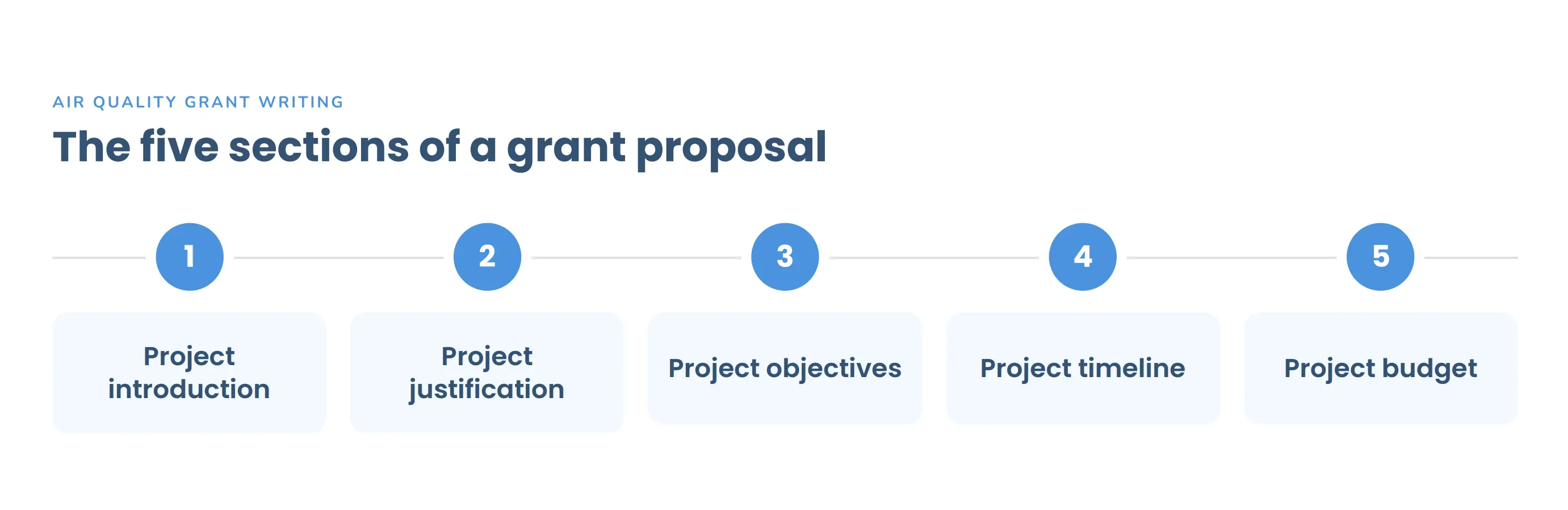
According to the United States Environmental Protection Agency (EPA), a grant proposal usually includes the following:
- 1. Project introduction: This section is similar to an abstract, and it explains what you are using the funds to achieve in a way that is easy to understand.
- 2. Project justification: This section defines and explains the specific air pollution issue that your project will address. It should cover why it is important to address the problem now, any data that identifies the need for action, and how people will be impacted by this project. Explore who will benefit from this project, and what your organization’s needs are.
- 3. Project objectives: The project’s objectives should mirror the things you are using grant funds for, such as implementing an air quality monitoring network. Be sure to focus on measurable and realistic performance outcomes rather than insubstantial goals. The project objectives will become the criteria by which the project is evaluated if you secure funding.
- 4. Project timeline/schedule: This section discusses the project’s planned start date and completion date along with any milestones and deliverables. It should cover any activities, responsible parties, and any steps that will be supported by grant funding. This section should also address how the project will be managed by your organization, including how services will be delivered and who is in charge.
- 5. Project budget: This section should include the costs associated with capital and non-capital expenditures and assumed in-kind services that are covered by the grant funds. It should be detailed and well-defined. Be sure to check the RFP or ask the grant coordinator how the budget should be organized, and account for inflation in your calculations. Contact us to better understand the costs of implementing an air quality monitoring network.
In addition to the above elements of a grant proposal, you should also include any supporting materials as requested by the funder, such as nonprofit verification materials and various financial documents. You may also want to include a cover letter and other elements to bolster your application.
Clarity now offers a grant Proposal Writing Tool, a comprehensive website that houses Clarity’s extensive knowledge on running an air quality sensor network and grant applications. It also contains specifications and case studies for Clarity’s products and services. You can access an AI grant writing tool that can draft proposals and boilerplate environmental grant proposal examples that you can draw from.
Grant writing for environmental nonprofits: What funders reward
Certain things can make your grant proposal more competitive. Funders reward the following:
- Community support: Look for individuals or groups that represent academic, professional, political, and volunteer organizations which may be able to support your proposal in writing. Be sure to set aside at least a few months in advance to negotiate letters of endorsement and financial or in-kind commitment from the right community groups. Consider forming a citizen advisory committee.
- Alignment with the funder’s mission: Successful grant proposals fit the philosophy and goals of the grant-seeking organization. Clearly express how your environmental project is necessary to address the funder's objectives.
- Clear communication: Environmental grant writing should be clear, succinct, and informative. Avoid unnecessary jargon. Ensure that the budget is easy to understand. Provide a clear and descriptive title. Consider using numbered lists where appropriate. Make sure that the different sections of your proposal tie together cohesively.
- Include measurable data: The goals of your project should be realistic and quantifiable. Use quantitative terms when possible. For instance, benefiting populations, timeframe, and projected outcomes should be defined with verifiable figures.
- Backup your claims with evidence: Whenever possible, include and cite credible research, statistics, case studies, reports, testimonials, and any other data that bolster your project's appeal.
- Tailored applications: Be sure that your grant application is tailored to the specific funder you are applying to. Even if you are sending out multiple applications to different grant opportunities, each application should be unique to the grant maker. You can reuse certain elements, but avoid simply repeating the exact same proposal.
- Create a narrative: Telling a compelling story can help make an application stand out. Grant proposals should tell a convincing narrative backed up by facts.
- Thorough review: Environmental grant writing is more polished, competitive, and ready for submission after thorough review by both the writer(s) and another colleague.
Real-world examples: Funded air quality monitoring proposals in practice
Many organizations around the world have already partnered with Clarity to secure air quality funding. We have aided grant writing for environmental initiatives and provided reliable air quality data to ensure optimal use of project funds.
Almaty and Bishkek
Supported by the Asian Development Bank (ADB), the governments of Kazakhstan and the Kyrgyz Republic led efforts to improve air quality in the cities of Almaty and Bishkek, in the Almaty - Bishkek Economic Corridor (ABEC). In 2021, 50 Node-S air quality sensors were deployed in Bishkek, supported by funding from the ADB, followed by the deployment of 50 more sensors in Almaty in 2022.
The air quality data provided by these sensors established a baseline to measure air quality improvement initiatives against. The data also aided the ABEC Clean Air Initiative, enabled multiple research projects, and notably helped secure $50 million in funding for the Kyrgyz Republic Air Quality Improvement Project.
When residents have access to information and know what level of air pollution is today, yesterday, and tomorrow, it helps to raise the issue of environmental safety in the cities and demand some measures. Or to make some small decisions at a personal level, such as insulating your house, wearing a mask, or not burning leaves.”
— Azhar Baisalova, Project Manager, MoveGreen Bishkek
Richmond, California
Richmond, California faces significant air pollution from industrial sources and dense freeways. Subsequently, the community faces elevated rates of asthma and disproportionately high respiratory and cardiac illness hospitalization rates. The environmental youth development organization Groundwork Richmond (AKA Groundwork) established a network of 50 Clarity Node-S air quality sensors in the region to help combat air pollution.
Reliable air quality data fostered community awareness, empowered locals to fight for clean air, and enabled the establishment of the Community Emissions and Exposure Reduction Plan (CERP). This air quality network would not have been possible without extensive grant money awarded by the California Climate Initiative through the California Air Resources Board’s AB 617 Community Air Grants Program. The program’s success made Richmond the blueprint for future AB 617 initiatives.
Securing line power for low-cost air quality monitors is a real challenge. The Clarity Node-S was the only low-cost air quality monitoring hardware that we knew was reliable and could operate off-grid - and stay online during blackouts. We installed the network in the summer of 2019 after the horrendous fire season of 2018, and we knew we didn’t have the luxury of relying on power supply in the Bay Area.”
— Matt Holmes, Air Quality Consultant and former Executive Director, Groundwork Richmond
Strengthen your proposal with Clarity
Clarity provides several resources to help you identify potential funding opportunities and create strong grant writing for environmental projects. Be sure to explore our Air Quality Funding Opportunities Collection and our EPIC Air Quality Fund page. Contact us for access to our Proposal Writing Tool.
Strong grant proposals include reliable air quality data. Clarity’s subscription model is appealing to grantmakers because it provides scalable, hyperlocal sensor networks, with no hidden costs. Partner with Clarity to secure funding and implement an accurate air quality sensor network.