TL;DR: Black carbon is a short-lived climate pollutant that comes from traffic-related air pollution, biomass burning, and fossil fuel combustion. A particularly harmful type of PM2.5, its outsized health and climate effects call for closer measurement than general particulate matter monitoring alone provides. Affordable network-deployable black carbon sensors differ from traditional aethalometers in cost, connectivity, scalability, and more.
Low-cost black carbon sensors offer a flexible, more affordable alternative to traditional fixed-site monitoring instruments. Network-deployable sensors enable hyperlocal monitoring with less maintenance.
What a black carbon monitor measures
Black carbon (BC), also known as soot, is a carbonaceous particulate pollutant that is released during incomplete combustion. It absorbs both light and heat.
Black carbon is a critical component of particulate matter air pollution, yet its unique properties encourage separate measurement. Black carbon may have a greater impact on human health than general PM2.5, and contributes significantly to climate change, with a warming effect 460-1,500 times stronger than carbon dioxide per unit mass.
Traffic emissions, household cooking and heating, industrial processes, and wildfire smoke are all sources of black carbon air pollution. This image is provided by Matt Palmer via Unsplash.
Networked sensor modules vs. traditional aethalometers: The core comparison
Both networked sensor modules (such as the Clarity Black Carbon Module) and more traditional aethalometers (such as the AE33 Aethalometer by Aerosol Magee Scientific) measure black carbon.
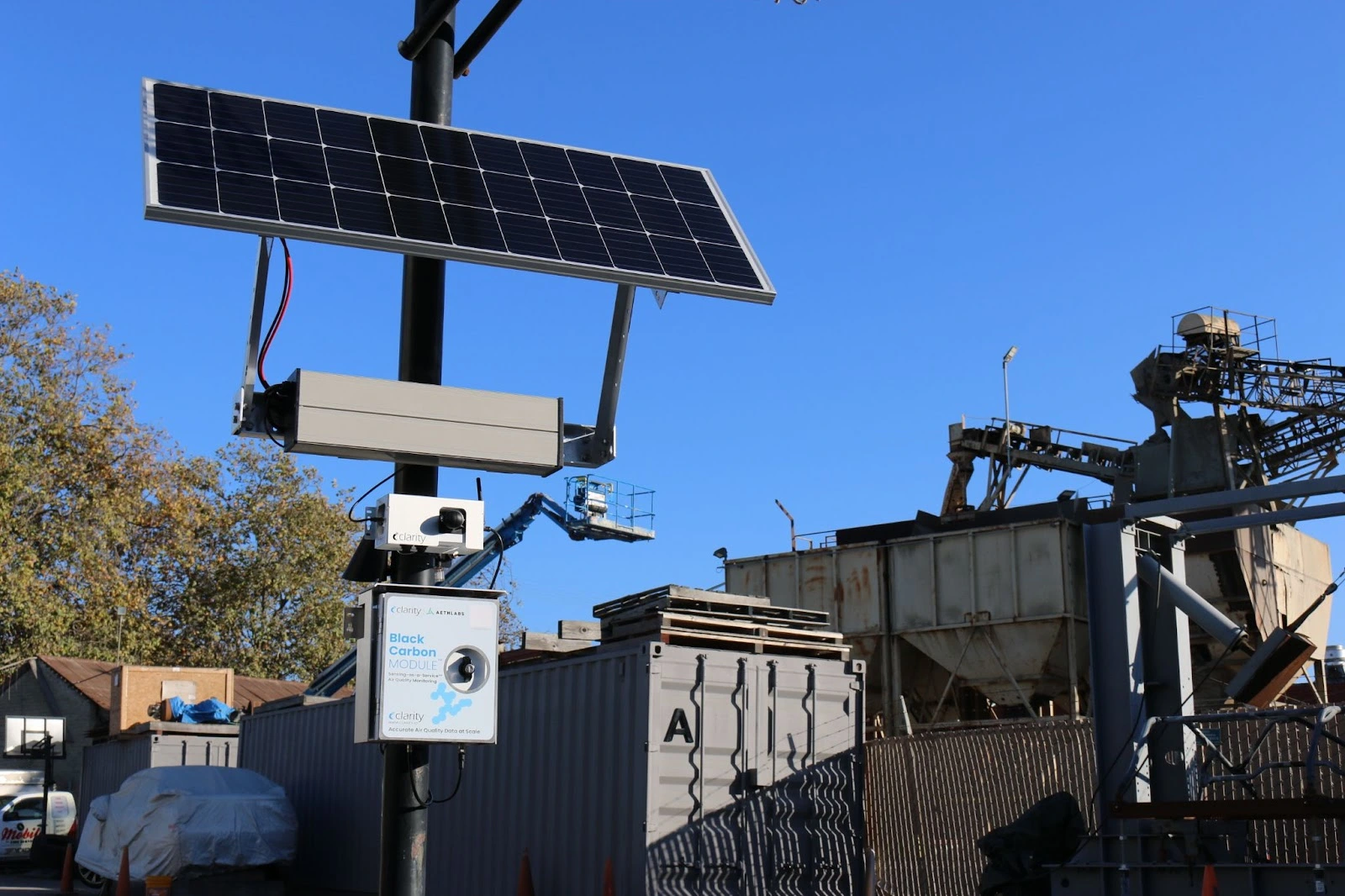
The Clarity Black Carbon Module, which uses microAeth® Black Carbon measurement technology from AethLabs, attaches seamlessly to our flagship Node-S air quality sensor. Together, they measure black carbon (BC), fine particulate matter (PM2.5), and nitrogen dioxide (NO2). The Black Carbon module can be powered off-grid with the addition of the Clarity external solar power system pictured here. The module also has an accelerometer, altimeter/barometer, and sensors for relative humidity and temperature.
However, these types of monitors differ in price, maintenance requirements, location flexibility, and scalability. Traditional black carbon analyzers are typically deployed at a single site or in a few sparse areas, whereas the Clarity Black Carbon Module is meant to be deployed as part of a dense network, building on hyperlocal particulate matter and nitrogen dioxide monitoring with the Clarity Node-S sensor.
Feature
Clarity Black Carbon Module
Traditional aethalometer station
Instrument class
5-wavelength aethalometer
7-wavelength aethalometer or varies depending on model
Installation and housing
Outdoors on pole or fence-line, with Node-S. The module is weatherproof, non-condensing, and UV-resistant
Usually housed in a separate, dedicated, environmentally controlled structure
Source apportionment
Biomass vs fossil fuel source apportionment included
There are often systems for remote management or manual downloads, but typically no native dashboard or easy access in real time
Source apportionment: Biomass vs. fossil fuel
The Clarity Black Carbon Module includes 5-wavelength spectrum measurements based on the optical signatures of various combustion sources. This means that the module can distinguish between different combustion sources, including diesel, woodsmoke, biomass, and tobacco. Source apportionment like this allows project managers to better understand and address black carbon air pollution hotspots, from traffic emissions to wildfire smoke.
Accuracy and validation
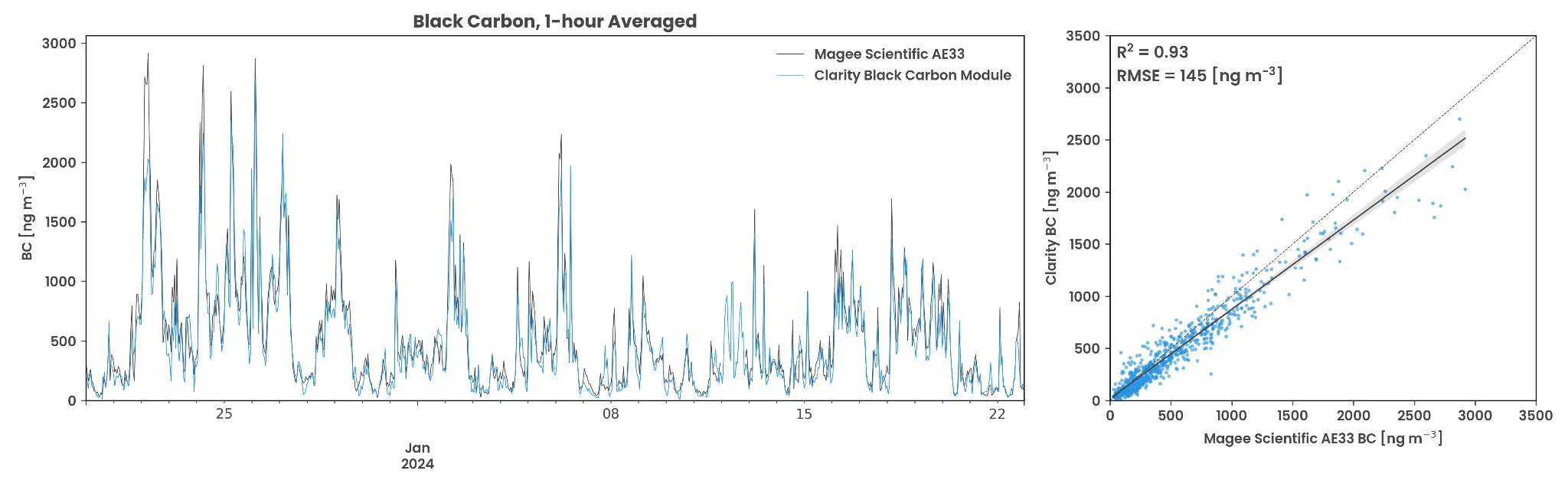
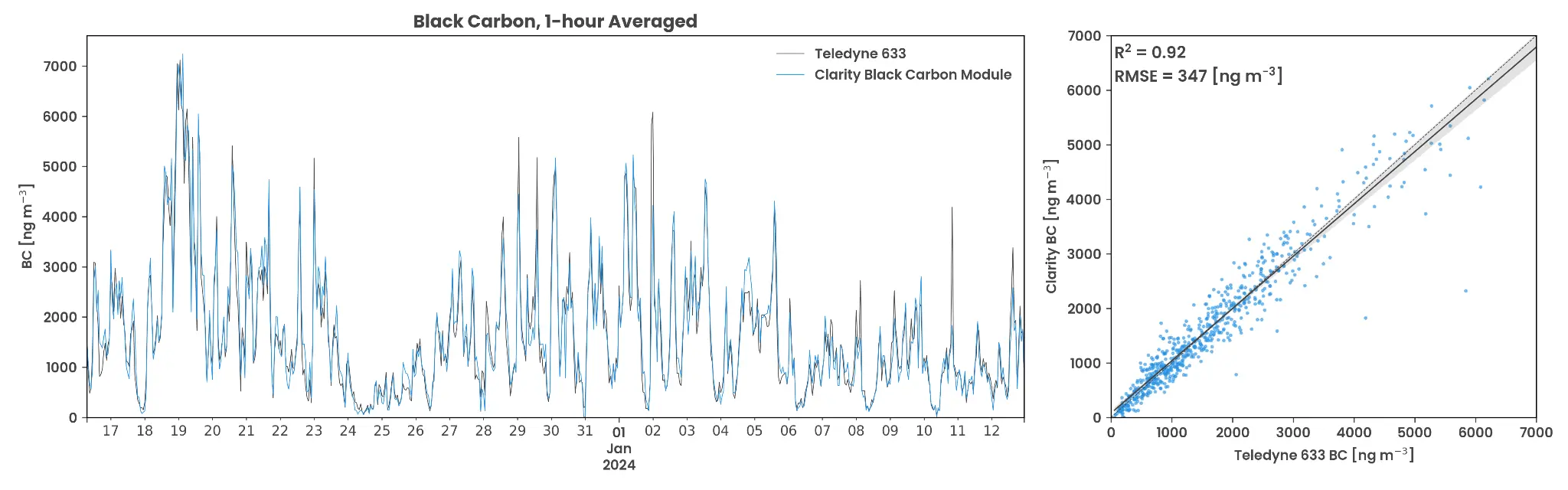
The Clarity Black Carbon Module has nearly the same accuracy as traditional aethalometer stations, such as Magee Scientific AE33, for a fraction of the cost. Our collocation results demonstrate how reliable our monitors are.
Collocation results comparing measurements from the Clarity Black Carbon Module vs. the Magee Scientific Aethalometer® Model AE33. An R2 of .93 was observed during the testing period.
Collocation results comparing measurements from the Clarity Black Carbon Module vs. the Teledyne Aethalometer® Model 633. An R2 of .92 was observed during the testing period.
Deployment, power, and cost
Networked black carbon sensors and traditional aethalometer stations differ in their deployment, scalability, and cost.
Factor
Clarity Black Carbon Module
Traditional aethalometer station
Cost per site
Lower
$30,000+
Sites per budget
Deploy at more sites for the same budget
Limited by cost
Power
Wired adapter or Clarity External Power System (which includes a solar panel for self-sustaining power)
Requires cabled power to operate
Connectivity
Cellular via Node-S
Wired / on-site network
Install effort
Pole / fence-line mount
Full shelter build-out
Which black carbon monitor fits which use case
Different monitors may be best for different circumstances. Traditional monitoring stations, such as the AE33 aethalometer, and networked sensors, like Clarity’s Black Carbon Module, can also be combined to form a more holistic picture of black carbon air pollution.
Use case
Typical driver
Best-fit approach
Traffic/roadside
Fossil-fuel BC, diesel
The Clarity Black Carbon Module can easily be placed near one or multiple busy traffic hotspots.
Wildfire smoke
Biomass BC, event response
The Clarity Black Carbon Module’s API, Dashboard, and Clarity Open Map enable easy public sharing in real time, so that citizens can make informed decisions about their safety in a timely manner.
Communities / Environmental Justice
Source attribution near hotspots
The affordability of the Clarity Black Carbon Module allows it to be highly scalable. The hyperlocal monitoring made possible by large monitoring networks means that sensors can reach underserved areas typically overlooked by traditional monitors.
Research campaigns
Depends on the particular project
Research that requires highly accurate black carbon data may find traditional monitoring stations more appropriate, but with near-reference accuracy, the Black Carbon Module is sufficiently accurate for most research campaigns
Network QA / Calibration
Testing and collocating sensor accuracy.
Traditional monitoring stations are generally considered the most accurate but often come at a high monetary cost.
Traditional and regulatory monitors are generally better for adhering to NAAQS. However, since there are no specific black carbon compliance regulations, traditional monitoring solutions, such as the AE33, serve as de facto regulatory-grade monitoring.
How the Clarity Black Carbon Module compares to other portable BC monitors
Not only is the Clarity Black Carbon Module a competitive choice compared to traditional aethalometers, but it also fares well against other portable black carbon monitoring options such as the Met One C12.
The Clarity Black Carbon Module is more affordable, low-maintenance, and highly sensitive. Greater source apportionment enables better identification of pollutant hotspots. The Clarity subscription model allows project managers to avoid unnecessary costs.
Feature
Clarity Black Carbon Module
Met One C12
Cloud communications
Uses cellular connection
Uses cellular connection
Pollutants measured
With the Node-S, the module measures fine particulate matter (PM2.5), nitrogen dioxide (NO2), and black carbon (BC).
Just black carbon (BC).
Wavelengths supported
Five wavelengths supported (880, 625, 528, 470, 375 nm)
Two wavelengths supported (880 nm with optional 370 nm).
Source apportionment
Real-time by default
Running average, only with 370 nm.
Detection Limit
Very sensitive detection limit (30 ng/m3)
Less sensitive detection limit (70 ng/m3)
Loading offset
Gold standard DualSpot® technique, but at a fraction of the cost. DualSpot® is a trademark of Magee Scientific Corporation used under license.
Tape advancement, which has higher consumable costs.
Tapes
Tapes are included with no extra cost, and cartridges are easy to install.
Tapes cost $89, may last only 2 months, and must be manually loaded.
Maintenance
Minimal maintenance. The dashboard allows for easy device status monitoring.
Monthly on-site maintenance.
How to choose a black carbon monitor
When selecting the right black carbon monitoring option for your project, you should consider various needs:
Do you require a single monitoring site or a network of monitors across a large area?
Does your chosen monitoring site or sites have adequate external power?
Do you intend to give real-time air quality data to the public, officials, or project managers?
Is your project budget better suited to traditional monitoring methods or to networked sensors?
Do you have the workforce capacity and technical expertise to cover traditional monitor installation, maintenance, and management?
Where the Clarity Black Carbon Module fits
The Clarity Black Carbon Module is best for large-scale network deployment. It has accurate air quality data and biomass-vs-fossil fuel apportionment. The module does not need a temperature-controlled shelter and can be made self-sufficient with our solar-powered addition. The Clarity Black Carbon Module combines seamlessly with our flagship Node-S sensor and integrates with our Dashboard and the Clarity OpenMap.
Get a quote today and partner with Clarity to integrate reliable black carbon air quality monitoring and ensure clean air in your community.
Key Takeaways
Networked black carbon sensors like the Clarity Black Carbon Module offer a lower-cost, more scalable alternative to traditional aethalometer stations for continuous black carbon monitoring.
The Clarity Black Carbon Module's 5-wavelength aethalometer enables source apportionment, distinguishing fossil fuel combustion and diesel emissions from biomass-burning sources such as wildfire smoke.
Traditional aethalometers remain the better fit for certain research campaigns and regulatory-grade accuracy, while networked sensors excel at real-time data sharing and expanding air quality networks into underserved communities.
Choosing between the two approaches depends on budget, site power availability, need for cellular connectivity and public data access, and available capacity for calibration and maintenance.
FAQ: Choosing a black carbon monitor
Is black carbon the same as PM2.5?
Particulate matter refers to solid or liquid particles suspended in the air, rather than any one specific substance. PM2.5 refers to particulate matter with a diameter of 2.5 micrometers or smaller. Black carbon, or soot, is a type of particulate matter which often comprises a major fraction of PM2.5. While not all PM2.5 is black carbon, all black carbon is considered particulate matter.
Can a black carbon monitor run on solar power?
The Clarity Black Carbon Module requires line power on its own. However, with the addition of the Clarity external solar power system, the module can run off-grid with solar power.
How many wavelengths are needed for source apportionment?
At least two wavelengths are needed for at least some source apportionment. However, the more wavelengths a black carbon sensor can measure, the more accurately it can attribute the sources of the black carbon air pollution. The Clarity Black Carbon Module offers real-time measurements across 5 wavelengths (IR, Red, Green, Blue, and UV).