TL;DR: Data centers face important air quality obligations under the Clean Air Act, including equipment-specific emission standards and permitting requirements for backup generators, turbines, and other stationary sources. Understanding which regulations apply, which pollutants to track, and how to site monitoring equipment appropriately can help data centers maintain compliance, support environmental reporting, and demonstrate accountability to surrounding communities.
Data center operators might consider air quality monitoring for various reasons. They need to identify the potential value of air quality monitoring, which air quality regulatory standards they must adhere to, what community environmental concerns they may need to address, what air pollutants to monitor, and how to implement an air quality monitoring program. A successful monitoring network can help fulfill both the needs of AI data centers and fenceline communities, while protecting the environment.
Why air quality monitoring matters for data centers
Air quality monitoring serves multiple functions for both data centers and surrounding communities:
- Regulatory & permit compliance: Data centers must comply with certain air pollution regulations, and air quality monitoring can help ensure they adhere to these standards.
- Equipment protection (corrosion): Certain gases and dust, as well as temperature and humidity conditions, can corrode data center equipment. Indoor air quality monitoring is appropriate to prevent these scenarios.
- Public health considerations: The air pollution from data centers can significantly harm the health of workers and surrounding communities. Air quality monitoring can help keep these emissions under control.
- Environmental considerations: Data center emissions can harm the environment and contribute to climate change. Air quality monitoring helps ensure emissions remain low.
- Community trust and ESG reporting: In addition to protecting public health and the environment, air quality monitoring can help instill community trust by showing transparency and accountability for their emissions.
Air quality standards for data centers
Air quality standards for data center ambient emissions are dictated by the Clean Air Act (CAA). In order to comply with the Clean Air Act, data centers must follow several specific protocols and rules, including permitting requirements and following specific air quality standards. Certain states also have stricter air quality policies than others, dictating more local emission requirements.
What to monitor: Key air quality parameters
Under the Clean Air Act (CAA), National Ambient Air Quality Standards (NAAQS) have been established for six criteria air pollutants, which are harmful to human health. Data centers should monitor for these pollutants to best comply with NAAQS standards. However, data center emissions also produce other harmful air pollutants that should be monitored to protect the fenceline communities and the environment.
How to set up air quality monitoring for a data center
It is useful to keep the following steps in mind when setting up data center air quality monitoring:
- 1. Define objectives: Discover which air quality standards and permitting requirements the data center must adhere to and how air quality monitoring can assist with meeting such requirements.
- 2. Determine the budget needs and how to meet them: The budget heavily impacts whether to use low-cost air quality sensors, which sensor brand to use, how many sensors to deploy, and what parameters can be measured.
- 3. Select monitoring equipment & parameters: Determine whether a reference-grade monitor or a professional-grade air quality sensor better meets the objectives, and which air pollutants to monitor to meet the objectives.
- 4. Plan air monitor siting: Meteorological data, community exposure, and air pollution hotspots all help determine where best to place air quality sensors.
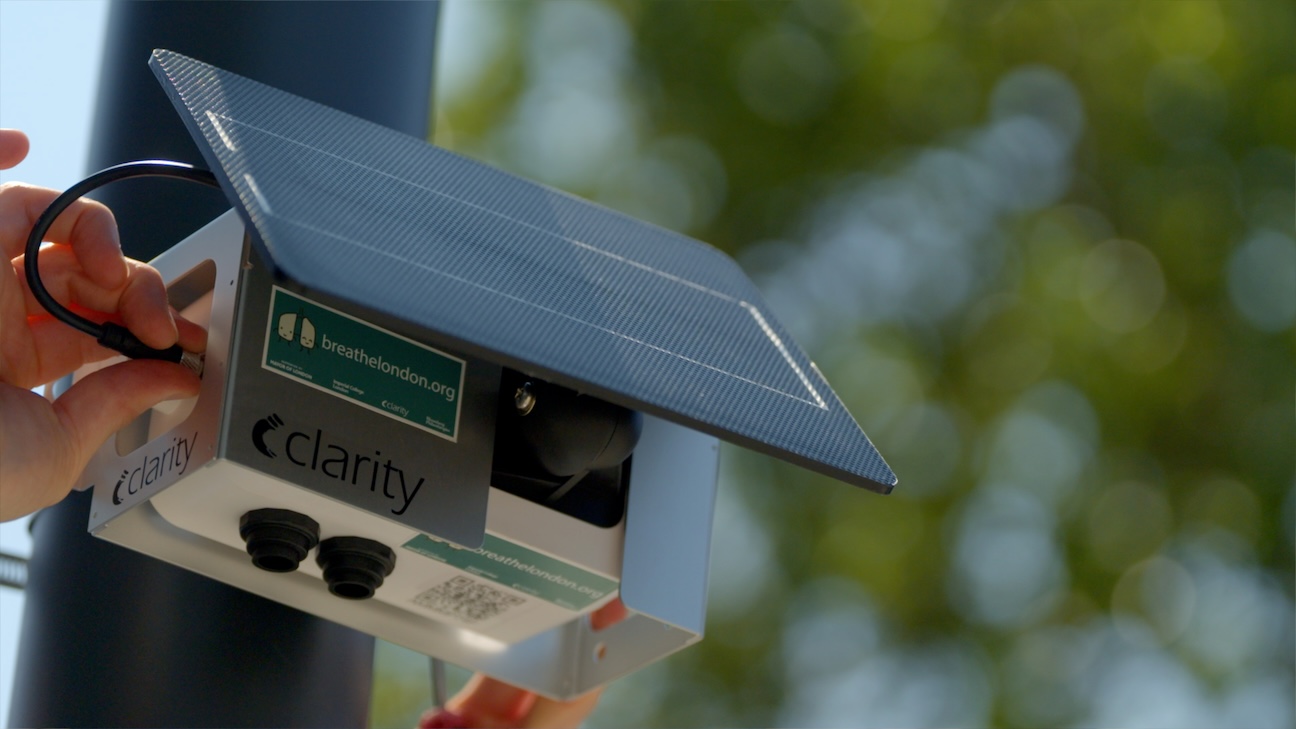
- 5. Deployment and data usage: Clarity’s solar-powered air pollution sensors are small and easy to deploy, saving on labor costs. Once deployed, take relevant actions based on the measured air quality data to ensure regulatory compliance and public health.
Real-world examples: Monitoring in action
Clarity has worked extensively with industries, providing air quality sensor networks that simultaneously benefit both industry and community. For instance, we partnered with First Quantum Minerals, a global copper company that operates mines in several countries, employing about 20,000 people around the world.
A subsidiary of First Quantum Minerals, Kansanshi Mining PLC, set up a fenceline air quality monitoring network for its Kansanshi Mine in Zambia. The network, which consisted of 6 Node-S air quality sensors, helped develop community relations, achieve operational compliance, and reduce maintenance costs.
There's less maintenance with Clarity's compact Node-S device — remote monitoring of device health means less cost to actually go to that particular site for maintenance. That time and cost-saving measure is critical for our business."
— Elisha Mulilo, Air Quality & Emissions Specialist, Kansanshi Mine
Air quality monitoring for data centers with Clarity
Air quality monitoring allows data centers to meet air quality standards and provide transparency for communities. Clarity’s Sensing-as-a-Service offering enables data centers and other project managers to deploy advanced Node-S air-quality sensors and related Add-On Modules via a cost-effective subscription model. Our expert calibration, easy data storage, solar-powered equipment, and weatherproof hardware facilitate effortless fenceline monitoring and policy compliance.